How Personalization Boosts Dwell Time at Live Events
People stay longer when an event gives them a reason to make something their own.
That idea sounds simple, yet it has real operational value. Dwell time is not just a vanity metric. It often reflects attention, emotional buy-in, conversation volume, and how willing guests are to keep participating instead of drifting past a station or leaving early.
Personalization works because it changes the guest from observer to contributor. Instead of receiving a branded item or watching a demo, attendees make choices, shape the outcome, and leave with something that feels connected to them. That shift can turn a passive activation into a social hub.
Why dwell time matters for live event performance
Longer dwell time usually means more touchpoints. Guests ask questions, compare options, take photos, invite friends over, and spend more time with the brand or host behind the experience. Those extra minutes can create stronger recall than a fast giveaway table ever will.
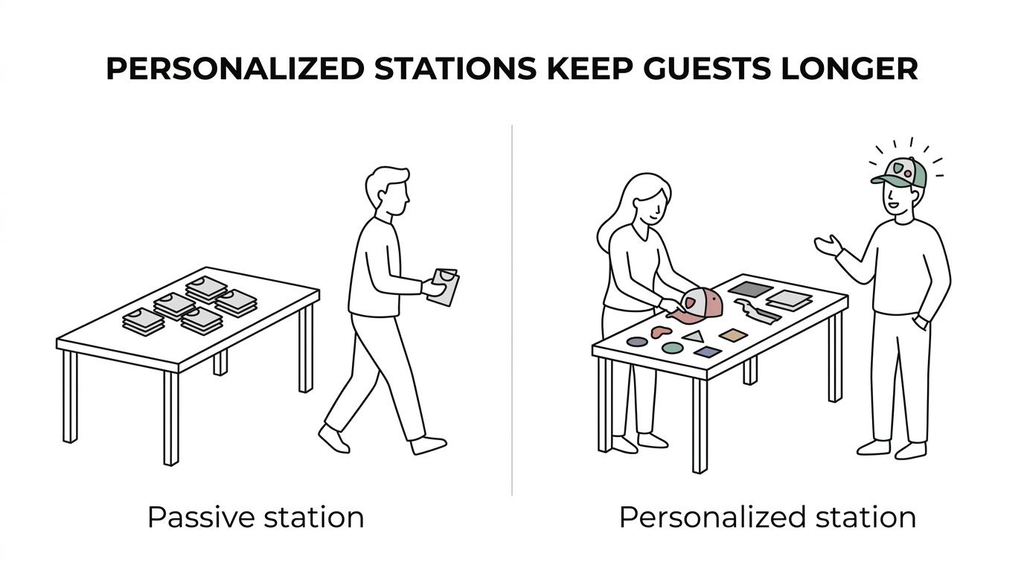
Side-by-side comparison of passive giveaway, photo moment, live demo, and personalized creation station, showing the personalized option leading to longer dwell time and stronger lasting value.
Research supports that connection. Cvent notes that personalization boosts engagement, strengthens brand loyalty, and improves the overall event experience. Cvent also points to dwell time by event area as a useful way to gauge attendee interest. That matters because interest is one of the clearest signals of event quality.
Freeman’s 2025 research adds another important layer. It reports that 90% of working professionals want personalized content and experiences, while 92% want variety and control over how they spend their time at an event. When people feel they have agency, they tend to stay involved longer.
Here is a practical way to think about it:
| Event element | What guests do | Likely effect on dwell time | Lasting value |
|---|---|---|---|
| Passive giveaway | Pick up item and move on | Short | Limited recall |
| Standard photo moment | Pose, capture, leave | Short to moderate | One shareable image |
| Live demo without interaction | Watch for a few minutes | Moderate | Product awareness |
| Personalized creation station | Choose, design, discuss, finish | Moderate to long | Personal keepsake plus memory |
The key is not merely keeping people physically present. It is keeping them meaningfully engaged while they are there.
How personalization gives attendees control and extends engagement
A personalized activation adds micro-decisions. Guests choose colors, textures, wording, accessories, or finishing details. Every decision invites another moment of attention. It also makes the station feel less transactional and more participatory.
That sense of control matters. A guest who picks their own design path is more invested in the result than someone handed a generic item. That investment creates a natural reason to stay through the full interaction, rather than treating it like a quick stop between other activities.
Pull quote highlighting that personalization changes the guest from observer to contributor.
It also changes the social dynamic. Personalized stations tend to attract small circles of conversation. People ask each other what they picked. They react to finished pieces. They watch the process and picture what they might create next. In many settings, the activation becomes part workshop, part lounge, part photo moment.
A few personalization ideas consistently hold attention well:
- Custom hat bars
- Live patch and pin stations
- Engraved accessories
- Scent blending bars
- Build-your-own gift kits
- Personalized calligraphy items
- Branded charm bars
Not every format delivers the same kind of dwell time, though. The best ones combine creative choice, visible progress, and an item worth keeping.
Event personalization ideas that naturally increase dwell time
Some activations are memorable because they are novel. Others work because they feel useful. The strongest event personalization ideas do both.
Wearable personalization is especially effective because it gives guests a reason to engage on-site and a reason to keep the item after the event. A custom hat, jacket patch, bandana, or tote becomes part of the guest’s look. That means the value does not end when they walk away from the station.
A personalized favor station can also shift attention from capturing a moment to creating an object. That difference is meaningful. A photo booth produces a fast hit of activity. A personalization station invites more deliberate participation. Guests slow down, make choices, and often stay nearby after finishing to compare results with others.
Custom wearable personalization creates longer engagement
Among wearable options, hat customization stands out because it blends style, craftsmanship, and visible self-expression. Guests choose a hat style, select materials or accessories, add patches, pins, branding, or embellishments, and leave wearing something they helped design.
That process is naturally sticky. It creates interaction at several stages: browsing, decision-making, design guidance, finishing, and social sharing. A mobile hat bar can become a gathering point rather than a simple queue, especially when guests are able to see each other’s designs take shape.
This is one reason wearable activations can outperform one-and-done experiences. The keepsake has immediate value, and it often earns repeat wear later. That translates into repeat impressions long after the event itself.
For planners looking at event ROI beyond the room, that matters.
How interactive keepsakes support brand trust and post-event behavior
Live events do more than entertain. They influence how people feel about a brand, a company culture, or a host’s attention to detail.
Freeman reports that 85% of attendees are more likely to make a purchase after an event. That stat should encourage planners to think bigger than attendance counts. The quality of the experience can shape what happens next, whether that means a sale, a follow-up meeting, stronger internal morale, or a more favorable memory of the brand.
Personalized keepsakes help because they feel chosen, not imposed. A guest who designs a wearable item is not just accepting a promotion. They are investing creativity into something they want to keep. That tends to create a warmer impression than an item selected only for mass distribution.
The effect is especially useful for corporate activations. A branded element can be integrated into the design without overpowering it. When the item still feels stylish and personal, guests are more likely to wear it later. That extends visibility in a way that feels authentic.
Measuring dwell time and attendee engagement without guesswork
It is easy to assume an activation worked because the line looked long. Real measurement is more useful.
Cvent points out that live events generate rich first-party data, which can support stronger personalization before, during, and after the event. Pair that data mindset with simple observational metrics, and planners can get a much sharper read on performance.
A few measurements are especially practical:
- Average dwell time: How long guests stay at the station from arrival to completion
- Participation rate: How many attendees take part relative to total event traffic
- Completion rate: How many guests start the activity and finish with a final item
- Social interaction: Photos taken, group participation, and organic sharing near the station
- Post-event visibility: Whether the keepsake is worn, reused, or shared after the event
Those data points reveal more than popularity. They show where the activation sat in the guest experience. Was it a quick novelty, or did it become a magnet that pulled people in and kept them engaged?
A strong personalization setup often improves more than one metric at once. Longer dwell time can coincide with more social content, stronger booth traffic, and higher perceived value per guest.
Personalization ideas for different live event goals
Not every event wants the same outcome. A wedding may want intimate memory-making. A trade show booth may want qualified conversations. A corporate party may want team bonding with strong visual impact. The personalization format should match the objective.
That is why planners should start with one question: what behavior do we want this station to create? More mingling, deeper conversation, branded visibility, or a premium takeaway?
Here are a few smart pairings:
- Corporate brand activation: Wearable items with subtle logos, brand-color materials, and expert guidance
- Wedding welcome party: Personalized hats or accessories that double as style pieces for the weekend
- Employee appreciation event: Creative stations that let teams relax, design, and leave with something useful
- Festival or community event: High-throughput customization with bold visuals and easy grab-and-go wearability
- Bar or bat mitzvah celebration: Age-flexible personalization that feels fun, social, and instantly shareable
A useful rule is to balance speed with meaning. If the process is too fast, dwell time drops. If it is too complicated, capacity suffers. The best activations create enough choice to feel personal without slowing the event to a standstill.
Why custom hat bars fit so many event personalization ideas
A hat bar works across many event formats because it checks several boxes at once. It is interactive, visually strong, highly giftable, and easy to adapt to different audiences.
Guests can usually choose from styles like trucker, rancher, or cowboy hats, then personalize them with trims, patches, pins, branding, and embellishments. That mix of structure and freedom is powerful. It gives people enough guidance to get started and enough choice to feel ownership over the result.
It also serves both personal and branded goals. For private parties, the focus may be style and self-expression. For corporate events, the same format can incorporate logos, theme colors, or campaign messaging in a way that feels more refined than handing out generic merch.
The experience tends to create momentum in the room:
- Guests gather around finished designs
- Conversation starts naturally
- Photos happen without prompting
- The keepsake leaves the venue with the guest
That final point deserves attention. When a personalized item leaves with the guest and gets worn again, the activation continues working after the event. A well-made hat can travel from the venue to dinner, the airport, another gathering, or a future social post. That kind of visibility is hard to match with disposable favors.
Planning personalization for capacity, flow, and quality
A great idea still needs clean execution. Dwell time rises for the right reasons when the station is organized, well-staffed, and easy to understand. It should feel active, not chaotic.
Staff guidance is especially important. Many guests like creative freedom, but they also appreciate quick help when choosing materials or pulling a look together. That guidance keeps the line moving and improves confidence, which can raise completion rates.
Layout matters too. A personalization station should invite browsing without blocking circulation. If guests can see options clearly, watch designs come together, and step aside to admire finished items, the station becomes part of the event’s energy rather than a bottleneck.
The strongest setups usually share three traits:
- Clear choices: Guests can understand the process quickly
- Visible craftsmanship: People can see quality materials and real design progress
- Built-in shareability: The final item looks good in photos and in real life
When those elements come together, dwell time becomes a sign of genuine interest, not friction. That is where personalization earns its place in modern event strategy. It gives attendees control, gives hosts stronger engagement signals, and gives the experience a life beyond the event itself.