
Branded Merch vs Live Activations
Some marketing choices keep a brand visible for months. Others create the kind of in-person energy that changes how people feel on the spot. When teams compare branded merch vs live activations, they are usually not choosing between “old” and “new.” They are choosing between two very different kinds of impact.
That distinction matters because both channels are still strong. Promotional products remain a major market, and live events are being treated more often as revenue drivers rather than brand extras. The better question is not which one is better in the abstract. It is which one fits the goal of the event, the audience in the room, and the action you want afterward.
For event planners, marketers, and hosts, this is where strategy becomes more useful than habit.
Branded merch and brand recall: where physical items keep winning
Branded merchandise performs well when the item is useful, visible, and easy to keep. That sounds simple, yet it explains why some giveaways disappear before the event ends while others stay in rotation for months.
Recent PPAI consumer research supports that pattern. In its study, 54% of consumers said they still have the last promo product they received, and 61% said they clearly remember the brand that gave it to them. The same research found that clear logo visibility and frequent use were major drivers of memory. In other words, merch works best when it earns repeated contact rather than relying on a one-time handoff.
That makes branded merch especially strong for long-lived recall. A tote bag on a grocery run, a water bottle at the gym, or a hat worn on vacation keeps the brand present in ordinary life. The impression is quiet, but it repeats.
The strongest merch usually shares a few traits:
- Useful in daily life
- Easy to carry home
- Visible branding
- Good design
- Repeated wear or use
This is also why generic volume often loses to thoughtful selection. A cheap item with no practical value may still count as a giveaway, but it rarely becomes a memory device. A well-made item that fits the audience can keep working long after the event floor is packed up.
Live activations and trust: where experiences move people faster
Live activations do something merch alone often cannot. They create interaction, attention, and emotion in real time. A guest does not just receive something. They participate, react, ask questions, post photos, and attach the moment to the brand.
That direct contact is where live experiences gain ground. Freeman reported that 77% of consumers said their trust in a brand increased after interacting with that brand at a live event. The same data showed strong word-of-mouth potential, with 67% of consumers saying they would want to talk about the brand or company to others after the interaction. Trust and conversation are not soft outcomes when they lead to referrals, better sales conversations, and stronger follow-up.
Revenue data points in a similar direction. Splash’s 2025 Outlook on Events, reported by Cvent, found that 66% of marketers running multiple event formats said in-person events generated the most revenue. It also found that 72% said prospects close deals faster after attending events. That is a powerful argument for activations when the goal is movement, not just memory.
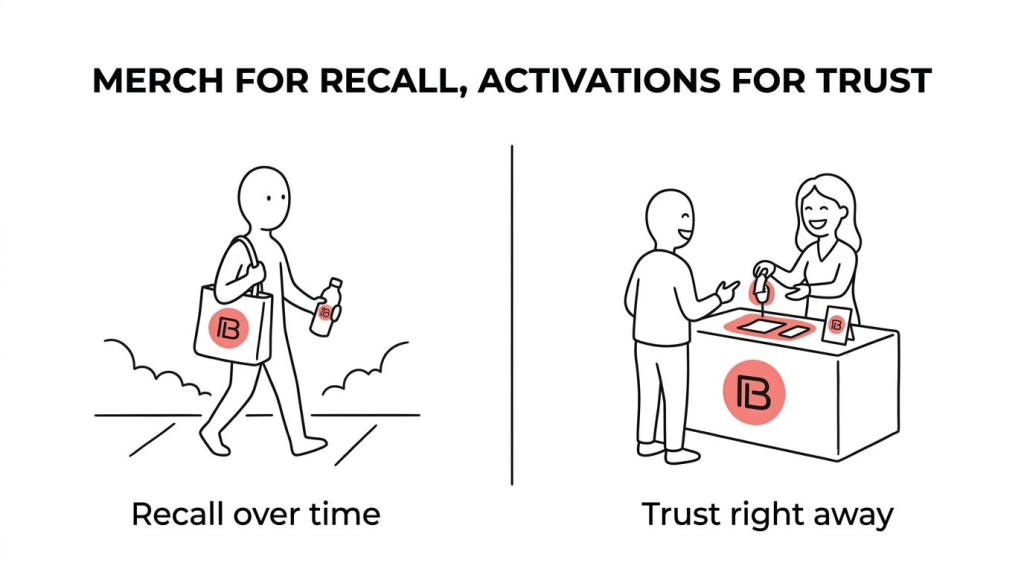
Side-by-side comparison of branded merch and live activations across recall, trust, engagement, and post-event visibility.
Live experiences can also create a different kind of scarcity. A guest knows the moment is happening now, in this place, with other people around them. That raises attention in a way that passive giveaways rarely can.
Branded merch vs live activations by event goal
The choice becomes clearer when the goal is stated plainly.
If the brief says “we need people to remember us three months from now,” useful merch has strong evidence behind it. If the brief says “we need to build trust, create buzz, and get people talking today,” live activations often have the advantage.
Here is a practical side-by-side view:
| Event goal | Branded merch | Live activations |
|---|---|---|
| Long-term brand recall | Strong fit | Moderate fit unless paired with take-home item |
| Immediate engagement | Limited on its own | Strong fit |
| Trust building | Moderate | Strong fit |
| Social sharing | Moderate if visually interesting | Strong fit |
| Lead acceleration | Indirect | Strong fit in many event settings |
| Budget efficiency at scale | Often strong | Depends on staffing, footprint, and format |
| Post-event visibility | Strong | Limited unless guests leave with something |
| Guest participation | Low to moderate | Strong |
This is why teams often misjudge the category. They compare the cheapest giveaway to the most polished activation, or they compare a passive merch table to an interactive branded buildout. That is not a fair test. The real comparison should be between outcomes.
Promotional products market growth shows merch is still commercially relevant
The market data also confirms that branded merchandise is not fading into the background. ASI reported that the North American promotional products market reached $27.7 billion in 2025, with 4.2% sales growth over the prior year.
That scale matters because it shows continued demand, not nostalgia. Businesses still buy promo products because the category delivers something clear: a physical brand reminder that can travel beyond the event.
Yet market size alone does not answer the planning question. Large categories can still be used poorly. A warehouse full of branded items does not equal impact. Relevance, quality, and audience fit still decide whether the spend works.
Hybrid event marketing: when merch becomes a live activation
This is where the comparison gets more interesting. Some event formats collapse the gap between branded merch and live activations by turning the product itself into the experience.
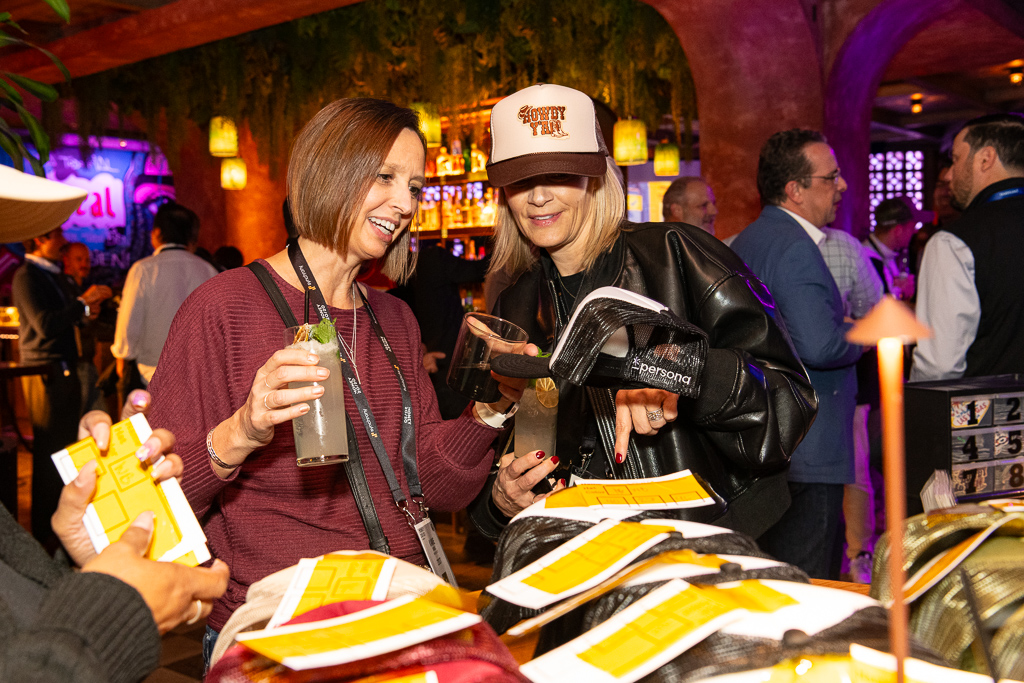
A guided custom hat station is a strong example. Guests choose a hat style, select patches or embellishments, and personalize the piece on site. The brand gets dwell time, conversation, and shareable moments during the event. The guest leaves with a wearable item that keeps showing up after the event. That is not merch versus activation. It is merch through activation.
Highlighted quote reading, “That is not merch versus activation. It is merch through activation.”
This kind of format is especially useful when teams want both immediate engagement and durable recall. The live component builds attention and trust. The finished item extends the brand relationship past the event.
The strongest hybrid activations tend to work because they combine several benefits at once:
- Participation: Guests make choices instead of receiving a preselected item
- Quality perception: Better materials often raise the perceived value of the brand
- Wearability: A hat, jacket patch, or accessory can keep the brand in public view
- Photo value: Customization naturally creates social content
- Memory anchor: People remember what they made, not just what they were handed
For event planners, this changes the budget conversation. A well-designed hybrid activation may cost more than ordering bulk giveaways, yet it can replace multiple line items at once: entertainment, guest engagement, premium swag, and photo moment.
Las Vegas event strategy: matching the format to the crowd
Las Vegas is a particularly useful market for this discussion because audiences here often expect more than a static booth and a bowl of branded pens. Trade shows, corporate off-sites, hospitality events, weddings, and private parties all compete for attention in a city built on experience.
That raises the standard for both merch and activations. A giveaway needs to feel worth keeping. An activation needs to earn its footprint, staffing, and queue time. When guests are moving quickly between sessions, receptions, and nightlife, wearable items tend to do well because they become part of the event itself.
A custom hat experience fits that environment naturally. Guests can wear the finished piece immediately, which helps the item function as both event participation and social proof. The room changes when attendees become part of the visual atmosphere.
If you are choosing between merch and activation for a Las Vegas event, it helps to pressure-test the plan against a few basics:
- What do you want people to do next?
- How much time will they actually spend with you?
- Will the item still matter after they leave the venue?
- Is the experience easy to understand in under ten seconds?
Those four questions can save a lot of money.
Budget decisions for branded merch and live activations
Budget debates often frame merch as the efficient choice and activations as the premium one. That can be true, but only at surface level.
Bulk merchandise usually gives predictable unit economics. You know your quantity, your decoration method, and your shipping profile. Live activations add labor, setup, real estate, and on-site operations. Still, cost per impression is not the same as cost per meaningful interaction.
A small pile of low-value items may be inexpensive, yet the waste can be high if guests do not keep them. A well-run activation may serve fewer people per hour than a grab-and-go table, though each interaction can be deeper, more memorable, and more likely to lead to follow-up action.
A practical framework looks like this:
- Choose merch first: when recall over time matters most and the audience values utility
- Choose activation first: when trust, conversation, and event energy matter most
- Choose both together: when the event needs immediate engagement and a take-home reminder
- Choose a hybrid format: when the budget must cover entertainment, branding, and premium swag in one move
That last option is often where event teams find the most value, especially when the activation itself produces the merchandise.
Metrics for branded merch ROI and live activation ROI
Measurement should match the format. Too many programs are judged by the wrong scoreboard.
Merch is often best tracked through retention, repeat use, brand recall, and earned impressions over time. Live activations are often better measured through dwell time, conversations, lead quality, social mentions, meeting conversions, and post-event pipeline movement. EventTrack’s research focus on attendee intent, dwell time, and purchase-oriented outcomes reflects that shift toward behavior-based measurement.
A better reporting approach separates what each format is meant to do.
- Retention rate of the item
- Brand recall after 30 to 90 days
- Average dwell time at the activation
- Social posting volume
- Lead quality or meeting count
- Post-event follow-up response
When those metrics are used correctly, the choice between branded merch and live activations becomes less ideological and far more useful. A giveaway can be smart. An activation can be smart. The best event strategy often starts by refusing to flatten them into the same tool.