CES Las Vegas Booth Activation: Drive Traffic with a Live Custom Hat Bar
At CES, attention is expensive.
Every aisle is crowded with product launches, giant screens, polished demos, and teams all trying to answer the same question: how do you get the right people to stop, stay, and remember your brand after the show floor clears?
That is where stronger CES booth activation ideas matter. A good activation does more than create a line. It creates interaction, conversation, photos, and a reason for attendees to carry your brand with them for the rest of the event. A live custom hat bar does exactly that. It turns booth traffic into participation and turns a giveaway into something personal, visible, and useful.
Why interactive CES booth activation ideas outperform passive swag
Standard trade show giveaways still have a place, but most of them create only a brief moment. Someone grabs a pen, a charger, or a stress ball, says thanks, and keeps walking. The brand impression is light, and the conversation is often shorter than a minute.
A live customization experience changes the pace. People pause. They ask questions. They look at materials, colors, and design options. They picture themselves wearing the finished piece. That shift matters because dwell time is one of the clearest signs that a booth is working.
Interactive exhibits consistently hold attention longer than static displays. That extra time gives booth staff more space to introduce the product, qualify leads, and connect the brand to a positive experience rather than a rushed pitch. At CES, where attendees are flooded with messages, that difference is powerful.
A custom hat bar adds another layer: the finished item is wearable on the spot.
That means your activation does not end when the guest walks away. The hat keeps moving through the convention center, hotel lobbies, rideshares, dinners, and social posts, extending brand visibility in a way that brochures and tote bags rarely can.
How a live custom hat bar drives CES booth traffic
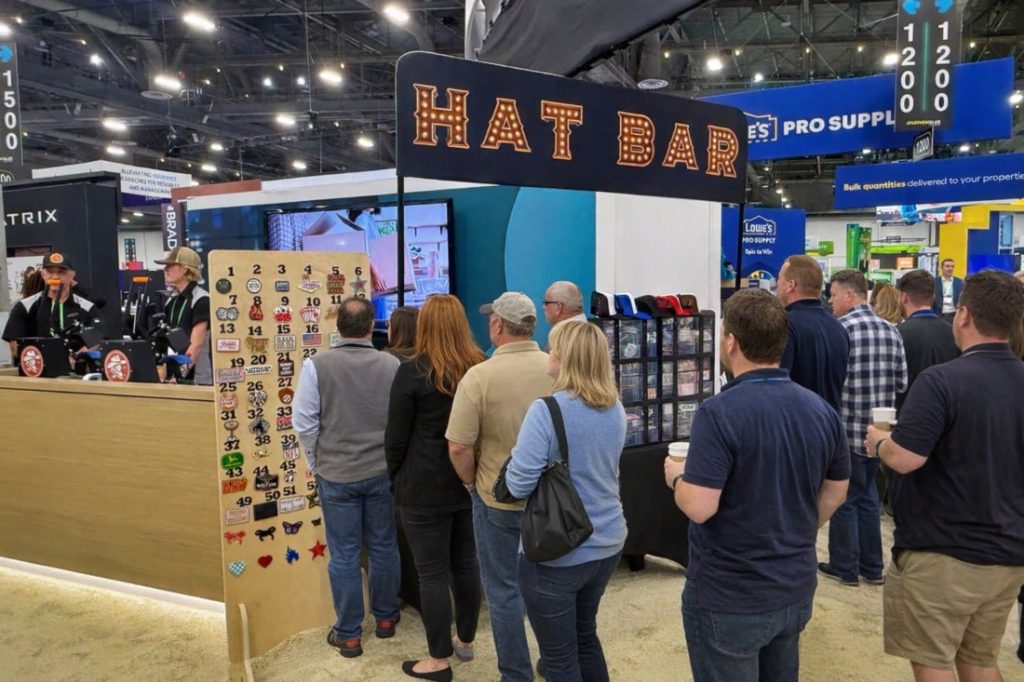
The first win is visual pull. A hat bar is active by nature. Attendees can see people choosing styles, comparing trims, trying on hats, and taking photos. That movement creates curiosity, and curiosity creates traffic.
The second win is clarity. Many booth activations fail because passersby cannot quickly tell what is happening. A custom hat bar is easy to read from a distance. People instantly understand the value: step in, create something, leave with it. That immediate appeal is useful on a trade show floor where decisions happen in seconds.
The third win is social proof. When a booth has guests actively participating, it signals relevance. Lines can be frustrating if they are poorly managed, yet a visible, organized queue also tells nearby attendees that the experience is worth waiting for.
After a booth begins attracting attention, these elements help keep the traffic strong:
- Tall branded signage
- Open entry points
- Finished sample hats on display
- Limited-time design drops
- A photo-ready backdrop near pickup
You can also create timed incentives that build momentum throughout the day.
- Morning rush: offer a limited patch or pin for the first group of participants
- Product launch tie-in: release a hat design element that connects to a demo or announcement
- Social post moment: invite guests to share a photo for a chance to unlock an upgraded embellishment
- VIP appointment layer: reserve select design options for pre-booked prospects or media meetings
That mix of visibility, urgency, and interaction gives the booth its own energy instead of relying only on signage and sales staff.
What makes a custom hat bar a smart fit for CES audiences
CES attendees are often drawn to things that feel new, efficient, and shareable. A live hat bar checks all three boxes.
It feels new because it is not another standard giveaway table. It is efficient because guests can complete a guided design in a short window if the menu is structured well. And it is shareable because the outcome is visual, wearable, and easy to photograph.
There is also a strong match between personalization and the CES mindset. People attending the show expect product customization, smart interfaces, and user-centered design. A booth activation that lets them build something that reflects their style fits naturally into that environment.
This matters for a wide range of exhibitors:
| CES goal | Typical tactic | Custom hat bar advantage |
|---|---|---|
| Increase aisle traffic | Screens, looping videos | Adds visible guest activity that draws curiosity |
| Improve dwell time | Product demo station | Extends conversation through guided participation |
| Create memorable swag | Standard merch giveaway | Produces a personalized item people want to wear |
| Boost social sharing | Photo wall | Adds a visual product guests can feature in content |
| Support brand recall | Printed collateral | Links the brand to a hands-on, positive experience |
For companies targeting buyers, media, creators, retail partners, or recruiting prospects, this style of activation can meet multiple goals at once. It does not need to replace product demos. It can strengthen them by giving your team a more inviting way to start the conversation.
How to design a branded custom hat bar for a CES booth
A hat bar works best when personalization happens inside clear brand guardrails. Too much freedom slows the line and weakens the brand. Too little freedom makes the experience feel generic.
The sweet spot is controlled choice.
That usually means a curated selection of hat styles, a defined color palette, approved logos or patches, and a thoughtful range of embellishments that reflect the brand identity. Guests still feel ownership of the final design, yet every finished hat still looks connected to the booth it came from.
For corporate teams, the most effective branded setups usually include:
- Curated hat styles: trucker, rancher, cowboy, or another silhouette that fits the audience
- Brand-coded palette: a controlled mix of neutrals and on-brand accent colors
- Approved marks: logos, taglines, icons, pins, or patches prepared ahead of time
- Retail-style packaging: bags, boxes, or wrap that make the takeaway feel premium
A polished presentation matters as much as the item itself. If the materials feel cheap, the brand impression drops. If the station looks intentional and stylish, the activation feels current and credible.
This is one reason mobile custom hat bar services have become attractive for trade shows and corporate events. A well-run team brings the styling guidance, the display logic, the setup, and the production rhythm needed to keep the experience polished under pressure.
Staffing and flow planning for high-volume CES booth activations
Even the best CES booth activation ideas can underperform if the booth flow is sloppy. A hat bar is highly engaging, but it needs structure. Without it, the line becomes messy, guests get confused, and valuable booth conversations get cut short.
Strong staffing solves that.
A good setup usually separates roles instead of asking one person to do everything. One team member greets and explains the process. Another manages the queue. Stylists guide the design choices. A brand representative can then step into the interaction naturally, without slowing production.
Flow matters just as much as staffing. The layout should guide people through a simple sequence: enter, choose base hat, select design elements, finalize, collect, then move to a photo area or product conversation zone.
Keep the experience moving with a few simple rules:
- Limit the design menu to the options that matter most.
- Display finished samples so guests can make faster decisions.
- Set up a clear entrance and exit.
- Use visible wait-time cues if traffic spikes.
- Keep the pickup and photo moment away from the design counter.
At CES, pace is everything. A booth can be packed at 10:30 and quiet at 11:15. Flexible staffing during peak windows is often the difference between an activation that feels exciting and one that feels chaotic.
How technology can support a live custom hat bar at CES
A hat bar is already interactive, so technology should support it rather than overpower it.
Simple digital layers can make the experience even stronger. A tablet-based menu can help guests preview approved options. A screen can show real-time branded visuals, recent guest designs, or a countdown to the next limited release. QR codes can send visitors to a landing page, contest, or meeting scheduler once they finish.
What works best is practical tech, not tech for its own sake.
Good additions often include short-form lead capture, social prompts, or a digital gallery of design inspiration. An AR try-on tool can be fun, though only if it is fast and reliable. If it slows the line, it works against the activation.
This is a useful rule for CES booth planning: if a digital layer speeds choice, sharpens branding, or captures data, it earns its space. If it adds friction, skip it.
Measuring results from a CES custom hat bar activation
A live activation should be measured like any other event investment. The visual buzz is great, but the real value becomes much clearer when performance is tracked.
Start with the basics. Count total participants, average wait times, hats completed per hour, lead scans connected to participants, and social mentions during the show. Then look at what happened around the activation. Did product conversations rise? Did scheduled meetings increase? Did the booth stay busier for longer periods?
Useful metrics often include:
- Total booth visitors during activation windows
- Hat completion volume by hour
- Average dwell time
- Lead capture rate
- Social shares and branded hashtag use
- Post-show follow-up response rate
The strongest activations also track quality, not just quantity.
- Traffic quality: were target buyers, media contacts, or partners joining the experience?
- Conversation depth: did the activation create more product discussions or only quick visits?
- Brand carryover: were guests wearing the hats later in the event or posting them online?
- Operational efficiency: did the booth keep a strong pace without crowding or confusion?
That fuller picture helps teams decide whether the activation created real business value, not just foot traffic.
Why premium execution matters for CES booth activations
Not every custom experience lands the same way. The difference is usually in execution.
A premium hat bar feels guided, polished, and easy to join. Materials look good on camera. Branding is consistent. Staff are warm, quick, and organized. The station feels like a featured part of the booth, not a side table with extra merch.
That level of execution is especially important at CES because the surrounding standard is high. Attendees are comparing your booth, often unconsciously, against some of the best-funded activations in the event world. If your customization station looks rushed, it will not carry the effect you want.
For brands exhibiting in Las Vegas, working with a local mobile custom hat bar team can simplify planning. Local support can help with setup logistics, staffing coordination, branding preparation, and event-day timing. For teams that want a custom hat experience built for trade show volume, Raising the Hat Bar is one example of a Las Vegas partner built around that kind of guided, on-site activation.
And that is the real opportunity here: not just giving people something, but giving them a moment they choose to step into.
When that moment is designed well, the booth gets busier, the conversations get better, and your brand leaves the hall on hundreds of heads instead of inside a tote bag.