Experiential Marketing in Las Vegas: Create-Your-Own Merch That Drives ROI
Las Vegas is built for attention, yet attention is not the same thing as impact. The Strip can hand you impressions by the million, but the brands that win are the ones that give people a role to play, not just something to watch.
That is why “create-your-own” merchandise has become one of the most practical experiential marketing ideas in Las Vegas. When guests design a piece of merch themselves, the item stops being a giveaway and starts being a personal artifact. The memory travels home on someone’s head, in their suitcase, and all over their camera roll.
Why co-creation works so well in Las Vegas
Las Vegas visitors and locals show up ready to participate. Many are Millennial and Gen Z travelers looking for stories, photos, and social moments more than passive shopping. That mindset favors activations that are fast to join, visually satisfying, and genuinely personal.
Co-creation also fits Vegas pacing. In a city that runs on tight schedules (conference breaks, show times, dinner reservations), the best experiential concepts deliver a clear “start, make, finish, take-home” arc. A custom merch station is naturally structured that way, and it makes ROI easier to measure because participation becomes a real count, not a vague estimate.
“Create-your-own merch” means more than printing a logo
When people hear custom merchandise, they often picture a standard imprint and a standard product. Experiential co-creation is different. The guest chooses, composes, and finalizes the piece, guided by staff who keep the process moving while protecting quality.
In Las Vegas, common versions include mobile hat bars, live embroidery, on-site screen printing, laser engraving, and even tech-forward souvenir concepts that use interactive screens to personalize purchases. The common thread is simple: the guest becomes the designer.
- Mobile hat customization station
- Live screen-print or embroidery booth
- Patch and pin “build table” for bags or jackets
- Laser-engraved drinkware personalization
- Interactive digital souvenir kiosk
The ROI logic: from attention to measurable outcomes
Experiential marketing ROI can feel slippery until you decide what you are buying. With create-your-own merch, you are usually buying a mix of four returns: participation, content, recall, and follow-up value.
A well-run station turns each attendee into a micro-campaign: they spend time with your brand, they leave with a branded item they helped design, and they often post it. One industry source notes that wearable branded items can drive strong recall, citing about 85% consumer recall for advertisers who provide shirts or hats. When personalization is part of the moment, that memory tends to stick harder because the guest invested creative effort.
Track ROI like an operator, not a poet. Set targets before the event, assign ownership for data capture, and make sure your team can act on what you learn.
A simple framework that works across conventions, festivals, and corporate events:
- Participation: number of items created, completion rate, average time per guest
- Content: hashtag mentions, tagged posts, photo share rate, creator shots per hour
- Commercial lift: on-site sales, post-event offer redemption, qualified leads captured
- Brand health: recall survey results, NPS-style satisfaction, repeat booking interest
The Las Vegas twist: location, timing, and “sensory competition”
The same activation can swing from average to exceptional based on where it lives. Vegas has a unique challenge: sensory competition. Guests are already being sold to with lights, sound, and spectacle. Your experience needs clarity. Not louder, clearer.
A create-your-own merch station succeeds when it answers three questions instantly:
1) What is happening here?
2) Can I do it quickly?
3) Will the result look good?
Timing matters too. Convention weeks deliver concentrated audiences that are easy to define and easy to retarget. Resort concourses and high-traffic corridors can bring volume, yet they demand visual simplicity and staff who can move a line without making it feel rushed. Off-Strip community events often deliver fewer total impressions, but stronger local connection and longer dwell.
High-performing experiential marketing ideas in Las Vegas (that guests actually finish)
Las Vegas is full of half-started brand interactions. People walk away when the line is confusing, the instructions are dense, or the payoff feels generic. The best co-creation ideas reduce friction and raise pride of ownership.
1) A mobile hat bar that produces wearable identity
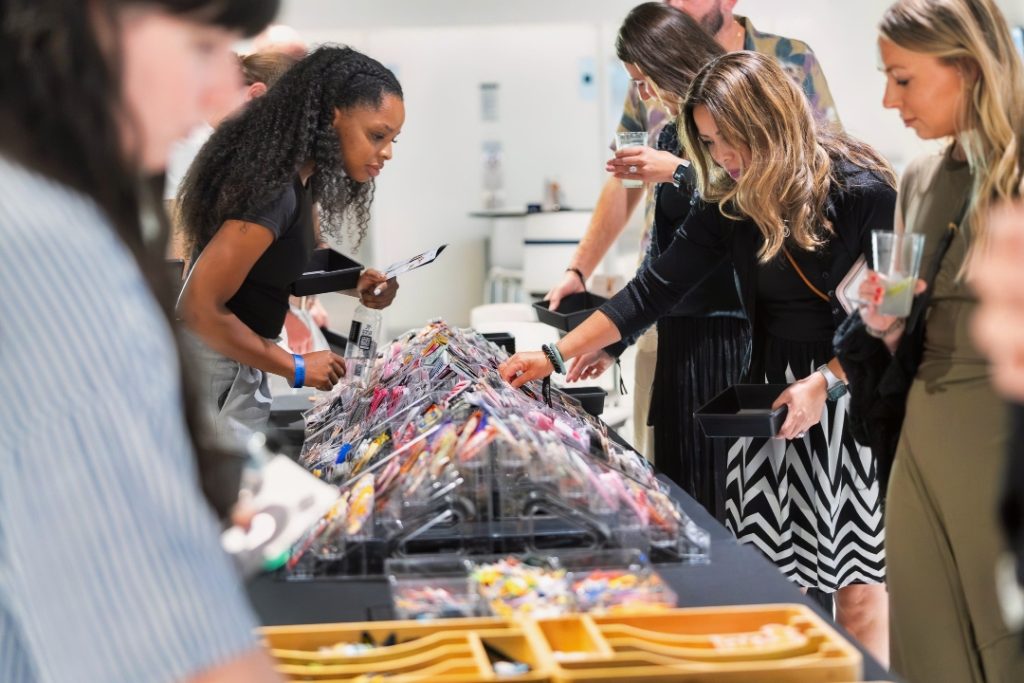
A hat is a billboard people choose to wear, and customization turns it into a statement. Guests can select a hat style (trucker, rancher, cowboy) and personalize with patches, pins, fabrics, paint accents, or branded elements. The strongest versions include guided design help, curated components, and a display that makes decision-making quick.
For corporate and brand events, hat customization can also support clean brand integration: logo patches, event marks, product icons, or limited-edition motifs tied to a launch. For weddings and social celebrations, it becomes a social glue, something people do together even if they arrived as strangers.
2) Live printing or embroidery that creates a crowd
Live production works because it signals value. People can see the item being made, which changes how they judge it. At trade shows, live customization has been reported to pull attendees in precisely because it is interactive and different from static displays.
This format fits tight time windows. A guest chooses a design, watches the process, and walks away with a fresh result. It pairs well with limited “drops” at the top of each hour, which can smooth lines and create urgency without pressure.
3) Interactive digital souvenir design for tourist-heavy zones
Tech-forward retail concepts on the Strip have shown how interactive screens and smartphone flows can let visitors personalize souvenirs quickly. Digital interfaces shine when inventory complexity is high (many SKUs, colors, sizes) and when shipping-to-hotel or ship-to-home improves conversion.
This approach is also a data win: it can tie preferences to contact details in a way that feels like service, not surveillance, as long as the value exchange is clear.
4) Micro-workshops that deliver a premium keepsake
Workshops like fragrance building, small-scale craft, or guided design sessions trade volume for intensity. When your audience is smaller but higher value, the longer dwell time becomes an advantage: deeper conversation, better lead quality, and stronger recall.
In Vegas, micro-workshops do best when the finished item is durable and travel-friendly.
A practical comparison table for planners
Below is a planner-friendly view of popular create-your-own merch formats, what they tend to measure well, and where they fit best in Las Vegas.
| Experience format | Best-fit Vegas settings | What guests take home | What you can measure cleanly | Operational notes |
|---|---|---|---|---|
| Mobile hat customization station | Corporate events, weddings, festivals, hospitality suites | A designed hat with branded or themed details | Items completed, average design time, UGC volume, opt-in leads | Needs strong layout to prevent “component congestion” |
| Live printing or embroidery | Trade show booths, sponsor lounges, pop-ups | Apparel or hats produced on-site | Hourly throughput, booth traffic lift, lead capture rate, redemption offers | Visibility of the process is part of the magnet |
| Patch/pin customization table | Brand activations, community events, retail pop-ups | Customized accessories or gear | Participation counts, photo moments, cost per unit | Fast, flexible, easy to theme |
| Digital personalization kiosk | Tourist corridors, retail experiences | Personalized souvenir shipped or carried out | Interaction counts, conversion rate, retargetable profiles | Works best with a frictionless UI and clear pickup/shipping plan |
| Premium micro-workshop | VIP events, smaller retreats, high-touch brand moments | Higher-end crafted item | Dwell time, satisfaction scores, qualified leads | Lower volume, higher perceived value |
Designing your activation around throughput and delight
ROI rises when the experience stays joyful even at scale. That is mostly an operations problem disguised as a creative one.
Start with throughput math: how many guests, how many minutes per item, how many staff, how many stations. Then design the creative options inside those limits. Counterintuitively, fewer choices can produce better outcomes because guests decide faster and feel more confident.
A planning checklist that keeps the experience moving while protecting quality:
- Decide your “hero item” and keep it consistent across the event.
- Build a component menu that supports your brand story without overwhelming guests.
- Map the guest flow (welcome, select, customize, finalize, photo moment, exit).
- Assign one staff role to line pacing and one to design guidance.
- Define your measurement plan before doors open.
Brand integration that feels like a flex, not an ad
Guests can spot forced branding instantly. In a create-your-own merch experience, branding works best when it behaves like design. That means logos become patches, icons become pins, and campaign phrases become tasteful options rather than mandatory placements.
A strong rule: the guest should feel stylish wearing the item a month later. When that happens, your brand earns repeated visibility without asking for it.
Here are brand-safe integration ideas that keep the merch wearable:
- Event mark: a small patch or pin that signals “I was there”
- Product iconography: simplified shapes and symbols tied to the brand
- Limited palette: two to four brand colors that work with neutral bases
- Customization tiers: quick build options plus a few premium upgrades
Measuring what matters, then using it
Las Vegas events generate plenty of energy. The marketers who justify budget are the ones who translate that energy into decisions.
If your goal is pipeline, prioritize lead quality and a post-event offer tied to the item. If your goal is awareness, prioritize content capture: a photo moment, a branded hashtag, and staff prompts that feel natural. If your goal is internal culture, capture satisfaction and participation across teams, then share the photo recap inside the organization so the value keeps compounding.
Create-your-own merch is not only an activity. Done well, it becomes a repeatable system: a clear guest flow, a clear data trail, and a tangible artifact that keeps working long after the lights of Las Vegas fade into the background.