8 Product Launch Activation Ideas That Get Shared
The most effective product launch activation ideas get shared because they combine three things at once: participation, a useful takeaway, and a clear visual story. If people can make something, wear something, or show something in a single interaction, the launch has a better chance of traveling beyond the room.
TL;DR: Summary
- The best product launch activation ideas combine a live experience with a useful branded takeaway, especially wearable customization stations like a hat bar, engraving bar, or patch bar.
- PPAI Research found that 54% of consumers still have the last promo product they received, and 61% remember the brand that gave it to them, which helps explain why useful launch merch can outperform disposable swag.
- Shareable launch activations need brand controls: a brand-approved menu, a limited-edition launch colorway, and a photo moment that makes attendee posts look intentional.
- Measure success with social media mentions, event hashtag use, attendee-generated content, participation rate, and throughput, not just booth traffic.
- If awareness is the priority, choose visually strong wearable activations; if product trial is the priority, pair sampling or demo with a physical item people keep.
That is why strong launch planning usually starts with one practical question: what will guests actually leave with, and why would they post it? The ideas and frameworks below focus on activations that support brand recall, fit real event operations, and give attendees something worth keeping.
Why do some product launch activations get shared while others fade?
Shared activations win when they pair usefulness with identity. PPAI Research and HubSpot point to the same pattern: people keep quality promo products, remember the brand, and generate measurable social content when the experience is easy to show and easy to keep.
A launch activation fades when it feels generic, disposable, or visually unclear. A guest may enjoy a momentary demo, but that does not mean they will post it later. Shareability usually rises when the attendee leaves with a branded object that still has value after the event.
The data supports that logic. PPAI’s 2025 research found that 54% of consumers still have the last promo product they received, and 61% clearly remember the brand that gave it to them. The top reason they keep the item is usefulness, with style and quality also playing major roles.
“Raising the Hat Bar treats an interactive hat station as a mini pop-up that travels to the event.”
A common mistake is treating “interactive” as the goal by itself. Interactivity helps, but only when it leads to an outcome people recognize as worth owning, wearing, or sharing.
What makes a product launch activation worth posting?
The best launch activations feel personal, branded, and camera-ready. Nike and Apple are useful benchmarks here because their launch environments usually make the product story instantly legible in photos.
People post what helps them say something about themselves. That often means the activation needs a visible identity layer, not just a logo in the background. Limited-edition elements, launch-specific names, customization choices, and a strong colorway give attendees a reason to claim the experience as their own.
There is also a timing issue. If the interaction takes too long, feels confusing, or produces weak visuals, the post never happens. A good rule is simple: if a guest cannot understand the experience in a few seconds, or cannot show the result in one photo, the activation is already losing momentum.
Highlighted quote stating that if guests cannot understand the experience quickly or show the result in one photo, the activation is losing momentum.
Pro tip: bigger builds do not automatically produce more shares. A smaller activation with a tighter concept often outperforms a large footprint that lacks a clear takeaway.
What are the best product launch activation ideas for shareability?
The strongest product launch activation ideas create a physical artifact and a posting trigger. Wearables, limited-edition customization, and tactile demos tend to outperform passive displays because they generate both memory and attendee content.
The best option depends on your product, venue, and audience behavior. These ideas work well because they connect launch storytelling to something a guest can keep, wear, or show.
- Mobile custom hat bar by Raising the Hat Bar: Guests choose a trucker, rancher, or cowboy hat and personalize it on-site with launch-approved patches, pins, colors, and embellishments. This format works especially well when built around a launch capsule, a branded menu, and a nearby photo moment.
- Limited-edition patch bar: Guests customize jackets, totes, or hats using a launch-themed patches set. It is faster than full customization and works well when throughput matters.
- Live engraving station: Names, initials, or short launch phrases added to drinkware, tech accessories, or fragrance caps create a premium feel with strong gift value.
- Interactive product demo lab: Ideal for beauty, wellness, food, beverage, or tech products where trial is the message. The key is making the demo visible enough for others to understand from a distance.
- Mystery drop vending machine: Good for hype-driven launches and creator events. It works best when entry is gated by an event action like scanning, posting, or completing a challenge.
- Photo-led installation with a collectible takeaway: A branded set alone is rarely enough. Add a wearable or portable object so the post continues after the guest walks away.
- Customization bar tied to the launch colorway: This can include caps, laces, cases, notebooks, or sleeves. The tighter the menu, the more on-brand the results look.
- Sampling lounge paired with branded build-your-own packaging: This is strong for consumables and beauty categories. Sampling gets trial, while packaging personalization increases retention and sharing.
Selection matters more than novelty. If your audience includes media, creators, or style-conscious attendees, wearable customization usually has the edge over static décor because it continues to appear in content after the event ends.
How do you design a launch-specific customization station step by step?
A launch-specific customization station works best when the guest choices are real but curated. Raising the Hat Bar and similar experiential vendors often use brand controls so the outcomes feel personal without drifting away from the campaign.
Start by defining the story before you define the materials. The station should reflect the launch, not just the brand in general. That is why teams often build the activation around a launch capsule instead of opening the full design library.
- Step 1: Define the launch capsule with 3 to 5 colors, textures, shapes, or phrases tied to the product release.
- Step 2: Set a brand-approved menu that controls logos, patch options, embellishments, and placement rules.
- Step 3: Add the share trigger with a mirror, signage, event hashtag, packaging, and a nearby photo moment.
If you leave every option open, the results may feel off-brand and slow down production. If you control too much, the experience can feel like prepackaged swag. The sweet spot is guided creativity, where the guest feels ownership and the brand still recognizes itself in every finished piece.
“Raising the Hat Bar recommends a brand-approved menu so every finished hat still feels like the brand.”
How should you balance brand control with guest creativity?
The right balance is controlled freedom. Launch teams and experiential agencies usually get better results when they lock the palette and core assets, then let guests choose among approved combinations.
This is where many launches either become chaotic or forgettable. If every patch, color, and phrase is allowed, the station can drift away from the product story. If every hat or item looks identical, guests stop feeling like creators and start feeling like recipients.
A practical approach is to decide early what must stay fixed and what can stay open. Keep the launch colorway, logo treatments, hero materials, and packaging fixed. Let guests choose the silhouette, accessory mix, phrase selection, or accent placement. If compliance or brand governance is strict, narrow the menu. If the event is community-focused or lifestyle-led, open it slightly.
“Raising the Hat Bar pairs live customization with a photo moment to prompt attendee sharing.”
One misconception is that more options always create a better guest experience. In live activations, too many choices often hurt throughput, weaken cohesion, and make the line feel slower.
How do wearable launch activations compare with standard swag tables?
Wearable activations usually create stronger brand recall than standard swag tables. PPAI Research gives the clearest reason: useful promo products stay with people, and remembered items improve remembered brands.
A swag table is simple, fast, and cheap to distribute. That makes sense when the event goal is broad reach with minimal dwell time. The trade-off is weak emotional ownership. Guests receive an item, but they do not build a memory around making it.
Wearable activations create a different kind of value. They ask for a little more time, staffing, and planning, but they produce a visible experience plus a retained item. If the launch needs social mentions, attendee-generated content, and stronger memory, customization usually has the edge. If the launch only needs mass handout volume, a standard table may be enough.
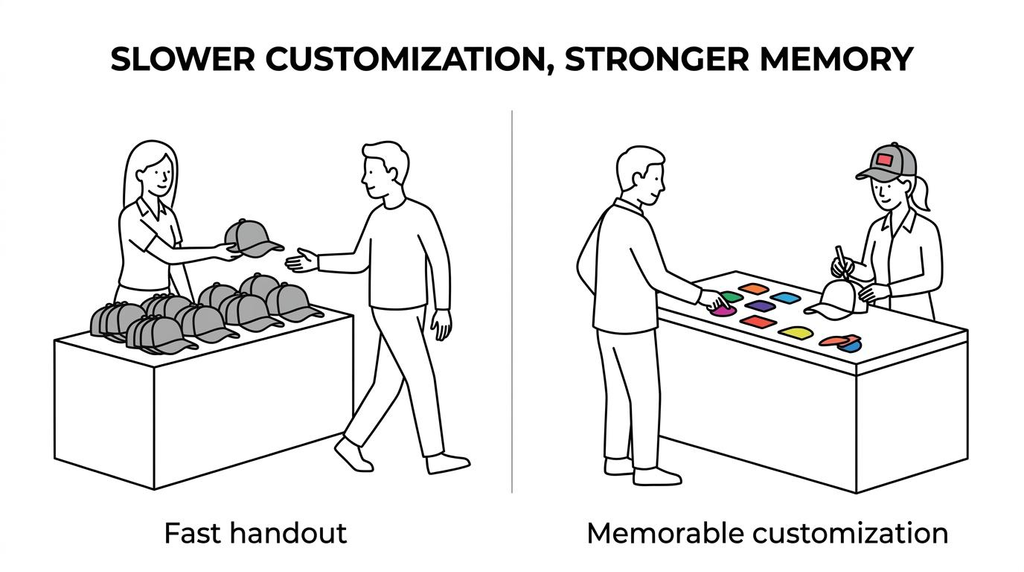
Side-by-side comparison of a wearable customization activation and a basic swag table, highlighting differences in recall, shareability, speed, and guest ownership.
The sharper question is not “custom or swag?” It is “what outcome matters more, speed or remembered participation?”
How do photo moments compare with pure sampling activations?
Photo moments are stronger for visibility, while sampling is stronger for direct trial. Brands like Glossier and Sephora often combine both because one drives content and the other drives product experience.
Sampling works when the product itself is persuasive after direct use, taste, scent, or touch. That is common in beauty, food, beverage, and wellness launches. The weakness is that sampling can vanish quickly from memory if nothing tangible remains after the interaction.
A photo moment works differently. It creates social proof and extends the event into feeds, stories, and tagged posts. Yet a backdrop alone is rarely enough. People are more likely to post when they are holding or wearing something connected to the launch. If you must choose one, pick sampling when conversion depends on trial. Pick a visual activation when awareness and reach are the main objective.
Pro tip: a photo area without a clear object in the attendee’s hands often produces weaker content than teams expect.
How do you plan throughput and staffing step by step?
Throughput planning is operational, not decorative. Event producers in Las Vegas and large conference markets know that the best concept can fail if the line moves too slowly.
The first planning pass should map interaction time, not just design ideas. A beautiful activation that backs up the program flow can hurt both guest satisfaction and event logistics.
- Map the average interaction from greeting to completion.
- Separate selection from personalization so guests make choices before they reach the maker station.
- Use dedicated staff for line management, design guidance, and final handoff.
If the guest count is high, tighten the option set and pre-sort materials by popularity. If the event is small and premium, you can allow more time per guest. This is where “throughput” becomes a launch metric, not just a staffing note.
How do you measure launch activation performance step by step?
The best measurement model tracks content, participation, and memory together. HubSpot highlights social media mentions and attendee-shared content as practical event metrics, and those signals are especially useful for launches built to be posted.
Many teams overfocus on foot traffic because it is visible in real time. Traffic matters, but it does not tell you whether the launch changed recall or generated content.
- Reach: Social media mentions, event hashtag use, creator tags, repost volume.
- Engagement: Participation rate, dwell time, queue conversion, completed custom items.
- Memory: Post-event surveys, code redemption, follow-up interest, retained promo product signals.
If the activation is tied to awareness, prioritize share rate and branded content volume. If it is tied to pipeline or sales, connect participation to scans, demos booked, or offer redemption. One metric rarely tells the full story.
How do you turn attendee content into post-launch momentum step by step?
Post-launch momentum comes from content structure, not luck. HubSpot’s guidance on event hashtags is useful here because attendee content becomes easier to find, group, and reuse when the publishing behavior is planned in advance.
First, create a simple content path at the event itself. The guest should know where to stand, what to hold, and what hashtag or tag to use. Next, make staff part of the content engine by prompting quick photos at handoff and reminding guests of the launch tag. Then, during and after the event, repost strong attendee content quickly while the product conversation is still fresh.
This is where wearable activations stand out. A custom hat, engraved item, or launch-themed accessory keeps appearing after the event in restaurants, airports, offices, and later social posts. That repeated exposure is hard to get from one-time sampling alone.
A final practical note: if user-generated content is a core KPI, secure brand-safe visual consistency before event day. Shared content performs better when every post still looks unmistakably tied to the launch.