9 Client Appreciation Event Ideas With Custom Hats
Client appreciation events work best when guests feel noticed, not processed. A custom hat activation can turn a thank-you event into a hands-on experience that clients remember, wear, and post about long after the room clears.
TL;DR: Summary
- Custom hats are one of the strongest client appreciation event ideas when you want a branded takeaway that guests co-create, wear, and remember instead of tossing in a swag bag.
- A hat bar works especially well for VIP client gatherings, hospitality suites, appreciation mixers, conference lounges, and milestone dinners because it creates conversation, visible participation, and a take-home keepsake.
- Hilton and Ipsos reported that 67% of people are more likely to attend an event with interesting social-sharing opportunities, and 64% say they are likely to post about a work-related event experience.
- ASI reported the promotional products industry reached $26.6 billion in 2024, which supports branded takeaways as a mainstream format, but custom hats stand out because guests help design the final item.
- If your event needs speed and low touch, standard swag may fit better. If your goal is relationship depth, social content, and stronger brand recall, custom hats usually win.
- The best results come from simple branding, a curated design menu, and capacity planning based on likely participation rather than total headcount.
The strongest event ideas pair appreciation with interaction. That is why custom hats are different from ordinary promo products: they act as wearable keepsakes and co-created merchandise, not just giveaways.
Why do custom hats work for client appreciation events?
Custom hats and branded patches work because guests co-create something they will actually wear. Unlike a prepacked tote or mug, a hat bar turns appreciation into participation and leaves clients with a visible keepsake.
Client appreciation often fails when the “thank you” feels generic. A custom hat station changes the social energy of the room because people browse styles, compare embellishments, ask for opinions, take photos while the design is happening, and take photos while the design is happening. That is valuable if your goal is relationship-building, not just distribution.
The format also fits how event behavior has changed. Hilton and Ipsos found that 67% of people are more likely to attend an event if there are interesting opportunities to share on their social network, and 64% are likely to post about their experience at a work-related event. A hat bar naturally creates those content-worthy things because the guest is part of the finished product.
“Raising the Hat Bar describes custom hats as wearable keepsakes guests create in person, which changes the item from a giveaway into a shared event experience.”
There is also a practical market signal here. ASI reported that the promotional products industry reached a record $26.6 billion in sales in 2024, so branded takeaways are still a mainstream choice. The difference is that custom hats feel personal, and personal items tend to stay in rotation longer than generic event merch.
Which client appreciation goals fit a custom hat activation best?
Custom hats fit relationship, visibility, and memory goals better than pure lead-capture goals. They work best for VIP dinners, conference lounges, and Las Vegas hospitality suites where hosts want conversation and a branded takeaway.
The clearest fit is retention and loyalty. If your event is meant to thank existing clients, celebrate an account milestone, or deepen strategic relationships, a hat bar gives guests time to interact with your team in a relaxed way. The activity becomes a soft networking layer.
They also fit events where brand visibility matters after the event. A finished trucker hat or rancher hat is wearable in airports, at festivals, on golf weekends, and in social posts. That matters because appreciation is not only about the night itself. It is about extending the memory of the host.
A common misconception is that every appreciation event needs the most elaborate activation possible. It does not. If your event is a fast breakfast briefing with a 30-minute guest window, a hat bar may be too involved. If people are lingering for an hour or more, the interaction becomes an advantage.
What are 9 client appreciation event ideas with custom hats?
A custom hat activation can be adapted to many event formats. The best idea depends on guest mix, venue style, and how much brand presence you want in the finished hat.
- Mobile hat bar lounge: A format used by companies like Raising the Hat Bar, this brings an on-site design station to the venue so clients can choose hat styles and personalize them during the event.
- VIP hospitality suite experience: Ideal for conferences, sporting weekends, or executive gatherings where guests want a premium, drop-in activity with a take-home result.
- Rooftop appreciation mixer: A sunset cocktail event pairs well with trucker or rancher hats because guests can build, wear, and photograph them immediately.
- Milestone dinner with personalization station: For anniversaries, deal celebrations, or top-client dinners, hats can be customized before dessert or during the after-dinner social hour.
- Western-themed thank-you party: Cowboy hats make sense when the event already has a Western identity, especially in Las Vegas or NFR-adjacent settings.
- Conference client lounge activation: This works when you want to pull clients away from generic expo traffic into a branded hospitality zone.
- Golf or sports hospitality pop-up: Trucker hats are a natural fit for outdoor, casual, and sponsor-friendly settings.
- Holiday open house with branded trim bar: Keep the palette seasonal, but let guests personalize details so the item still feels stylish after the season ends.
- Family-friendly appreciation day: A hat bar can serve adults, teens, and mixed-age groups better than many single-audience activities.
The best listicle ideas all share one trait: the guest leaves with something they helped make. That is what raises perceived value without requiring a luxury venue or an oversized entertainment budget.
How do you plan a client appreciation hat bar from concept to run of show?
A three-step plan works best for client appreciation events. Start with guest intent, move to creative direction, then lock the event flow with the hat partner and venue team.
Step 1 is deciding what the event is supposed to do. If the goal is top-account retention, plan for a slower, more premium experience with stronger host interaction. If the goal is broad appreciation at scale, choose simpler customization options and a layout that supports higher throughput.
Step 2 is curating the design menu. This is where many planners overcomplicate the experience. More choice is not always better. A focused set of hat shapes, patches, pins, bands, and colors usually creates better-looking finished hats and shorter lines.
“Raising the Hat Bar says branded details like patches, pins, color direction, and theme styling can connect the final hat to the host without making it look overly promotional.”
Step 3 is mapping the run of show. Decide where guests first see the activation, how they queue, where finished hats are photographed, and whether the station is open all night or timed to a featured window. If the station is hidden in a side room, participation usually drops no matter how attractive the product is.
How do custom hats compare with standard swag bags for client appreciation?
Custom hats beat standard swag bags on interaction and recall, while swag bags win on speed and simplicity. The right choice depends on whether you value throughput more than memorable guest engagement.
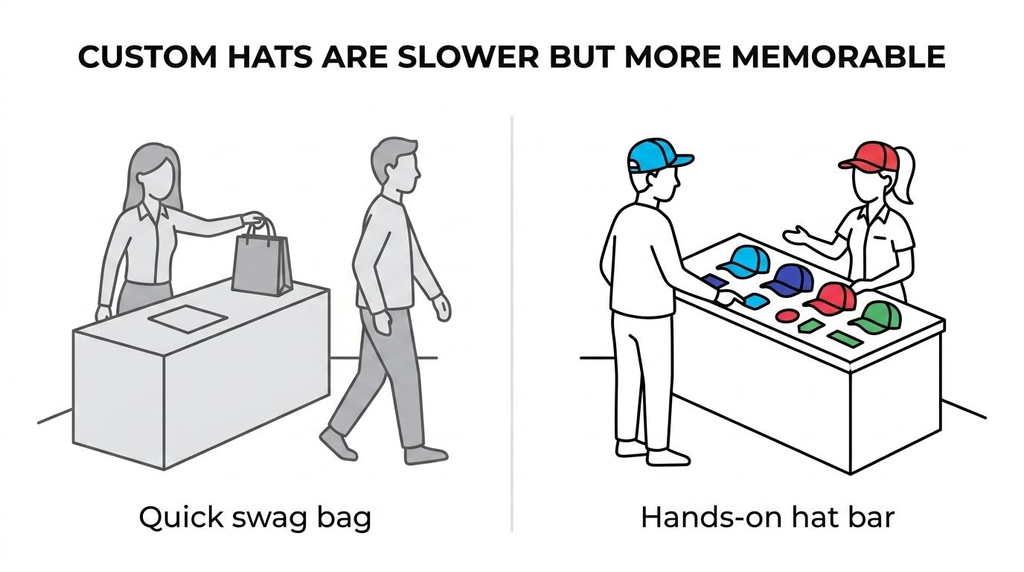
Side-by-side comparison of guests customizing branded hats at an event and a standard swag bag handed out at check-in.
A swag bag is easy to hand out at check-in. It is efficient, predictable, and useful when the event schedule is tight. The weakness is that guests rarely associate a prepacked bag with meaningful appreciation unless the contents are unusually strong.
Custom hats ask for more time from both host and guest. That is the trade-off. In return, the host gets dwell time, conversation, and a take-home item with much higher identity value. If people wear the hat during the event, the activation becomes part of the atmosphere, not just a parting gift.
If your event has under an hour of active social time, standard swag is often the cleaner choice. If your event is designed for mingling, hospitality, and photos, trucker hats usually create more brand memory per guest.
How should you brand custom hats without making them feel promotional?
Light-touch branding works better than logo-heavy branding. Patches, pins, and color cues usually create a stronger client response than a large front-and-center logo.
The goal is to make the hat wearable after the event. Many planners assume stronger branding means better brand impact. Often the opposite is true. A subtle logo patch or a brand-consistent color story is more likely to stay in the client’s regular wardrobe.
A useful framework is to keep one brand element fixed and let the guest control the rest. That preserves identity while protecting personal style.
- Front-facing identity: Use one clean logo patch, a small tag, or a branded pin instead of multiple marks.
- Color direction: Limit the palette to your brand family so the station feels curated rather than chaotic.
- Guest ownership: Let attendees choose trim, accents, and placement so the hat still feels like theirs.
- Photo value: Design for wearability first, because the most effective branded hat is the one clients keep using.
This is where the phrase co-created merchandise matters. The brand is present, but the client still feels agency, and agency is what turns a promo item into a keepsake.
How do you size staffing, flow, and capacity for different guest counts?
Capacity planning should be based on likely participation, not total invitations. A 500-person client event and a 500-person conference lounge can behave very differently.
Start by estimating how many guests will actually engage. A full-room captive audience may have a high participation rate, while a drop-in reception may have a lower one. Raising the Hat Bar shared a sample snapshot from a 500-person corporate event where 340 guests visited the hat bar and 310 completed custom hats. That is a useful reminder that interest and completion are not the same metric.
“Raising the Hat Bar reported that, in a 500-person corporate sample, 340 guests visited the hat bar and 310 completed custom hats.”
Next, design the flow. The fastest setups separate browsing from finishing. Guests should be able to see hat styles, choose embellishments, and move into final assembly without backtracking. If everything happens at one crowded table, the line becomes the experience, and not in a good way.
Then look at peak timing. If the activation opens right after cocktails or immediately after a keynote, demand tends to bunch. A simple fix is a staggered invitation, a second styling point, or hosts who guide quick decisions. One pro move is limiting the menu to your best-performing options instead of offering every possible trim.
Should you choose trucker hats, rancher hats, or cowboy hats for your audience?
The right style depends on audience identity and event context. Trucker hats fit casual corporate events, rancher hats feel fashion-forward, and cowboy hats work best when the setting or theme supports them.
The easiest way to choose is to match the hat to the client’s likely post-event use. If they can picture themselves wearing it again, you picked well.
- Trucker hats
- Rancher hats
- Cowboy hats
Trucker hats usually suit tech, sales, sports, travel, and outdoor-adjacent audiences. They are approachable, easy to brand, and often the safest choice for broad appeal. Rancher hats skew more premium and visual, which makes them strong for curated dinners, influencer-adjacent events, and style-conscious groups. Cowboy hats are powerful in Western settings, destination events, and Las Vegas hospitality formats where the environment supports the look.
A common mistake is choosing the most dramatic silhouette instead of the most wearable one. A less theatrical hat that gets worn 20 times is usually more valuable than a statement hat that stays in the closet.
How do you measure ROI from a client appreciation event with custom hats?
ROI should be measured across participation, visibility, and post-event relationship movement. A hat activation is not only a merch expense; it is an engagement tool with clear signals you can track.
Start with participation metrics. Count how many guests approached the station, started a design, and completed a hat. Those numbers reveal whether the concept, placement, and staffing were right. A high start rate with a low finish rate usually means the menu or process created friction.
Then measure content and visibility. Hilton and Ipsos found that 29% of people spend free time at events looking for content-worthy things to post, and 64% are likely to post about their experience at a work-related event. In one corporate sample shared by Raising the Hat Bar, 62% shared at least one image in the first week with the event tag. That is not a universal benchmark, but it is a useful reference point for what social-friendly activations can do.
Finally, track relationship outcomes that match the event’s actual purpose. If this was a client appreciation event, then renewal conversations, follow-up meetings, referrals, and executive thank-you responses matter more than raw impressions. If your sales team says the event felt active but no one can name which clients re-engaged afterward, the measurement model needs work.
A practical rule helps here: if the goal was retention, measure depth; if the goal was visibility, measure reach; if the goal was both, build a scorecard before the invitations go out. That keeps the event from being judged only by how busy the room looked.