
11 Trade Show Giveaway Ideas That Get Used
Most trade show giveaways fail for one simple reason: they are easy to take but not worth keeping. The best giveaway ideas get used because they solve a small daily problem, start a real booth conversation, or become part of what the attendee already wears, carries, or keeps on a desk.
TL;DR: Summary
- The best trade show giveaway ideas are useful, wearable, or interactive, because those items are more likely to be kept and remembered than generic swag.
- PPAI Research reports that 54% of consumers still have the last promo product they received, 61% remember the brand that gave it to them, and usefulness is the top reason people keep branded items.
- If your goal is lead generation, pair giveaways with a one-on-one conversation, since trade show research has tied that tactic to stronger exhibitor engagement.
- Wearable giveaways like hats can create repeat impressions after the show, while tech items work well when they solve a real mobile or desk need.
- If you want longer booth dwell time, an interactive giveaway activation like a custom hat bar can outperform passive swag by turning the item into a live experience.
That shifts the decision from “What can we hand out cheaply?” to “What will people still use next week?” Once you make that shift, the shortlist gets clearer, the budget gets easier to defend, and the giveaway starts supporting booth outcomes instead of just filling a bowl.
Why do useful trade show giveaways perform better?
Useful items win. PPAI Research and 4imprint survey findings point to the same pattern: attendees keep promo products when they fit real routines, and brand recall improves when the item stays in circulation.
PPAI Research found that 54% of consumers still have the last promotional product they received, and 61% clearly remember the brand that gave it to them. The same body of research says usefulness is the top reason people keep branded items, while style and quality also matter. That is a strong reminder that utility alone is not enough if the item feels flimsy or dated.
A common mistake is treating giveaways as disposable impressions. That looks efficient on a spreadsheet, but it can be expensive in practice if most of the pieces are forgotten before the attendee even gets home. A smaller quantity of better-fit items often produces better recall, better conversations, and a cleaner booth experience.
What criteria should you use to choose trade show giveaway ideas?
Choose by fit, frequency, and conversation value. A power bank and a branded cap usually outperform a random trinket when the item matches attendee context and gives booth staff a reason to talk.
Start with the attendee, not the catalog. A healthcare buyer walking a massive expo hall has different needs than a festival sponsor guest or a software prospect flying home with only a carry-on. If the item is hard to pack, awkward to explain, or too generic to tie back to your offer, it will struggle.
The strongest screening criteria are simple:
- Usefulness: Does it solve a daily, weekly, or travel problem?
- Brand fit: Does the item make sense for your company category and audience?
- Quality perception: Will the material, finish, and packaging feel credible?
- Conversation value: Can staff use it to start or deepen a one-on-one exchange?
- Portability: Can attendees carry it through the event and onto a plane?
If two items cost about the same, choose the one that is easier to use immediately. That is often the difference between a giveaway that gets packed with intention and one that gets abandoned in the hotel room.
“Raising the Hat Bar describes a custom hat bar as a staffed, on-site personalization station built into the exhibit footprint, turning a giveaway into a real booth interaction.”
What are the best trade show giveaway ideas that get used?
The best trade show giveaway ideas are practical, visible, and easy to keep. Wearables, charging tools, and premium everyday items tend to outperform novelty pieces because they earn repeat use.
If your audience includes buyers, sales teams, recruiters, media, or event professionals, think in terms of “What will this person still use in transit, at work, or on weekends?” That lens usually leads to better choices than chasing the cheapest unit cost.
- Custom hat bar activation, such as Raising the Hat Bar: Guests personalize a wearable hat on-site, which turns swag into a live booth experience and a take-home item.
- Premium branded hats: A well-designed trucker, rancher, or dad cap keeps working after the show if the style is actually wearable.
- Power banks: Still one of the safest bets for heavy phone users walking large venues.
- Wireless charging pads: Best for office-based audiences who want a permanent desk item.
- Insulated tumblers or water bottles: High repeat use when size, lid quality, and finish are solid.
- Structured tote bags: A good tote gets used during the event and often afterward for commuting or errands.
- Phone stands or magnetic wallets: Compact, travel-friendly, and visible during everyday use.
- Quality notebooks with a strong pen: Not exciting on paper, but still highly usable if the materials feel premium.
- Travel cable kits: A smart fit for B2B events with frequent flyers and device-heavy attendees.
- Microfiber tech cloths with cases: Simple, inexpensive, and surprisingly sticky when aimed at laptop users.
- Packing cubes or travel pouches: Especially effective for audiences that attend multiple events each year.
How should you match trade show giveaway ideas to booth goals?
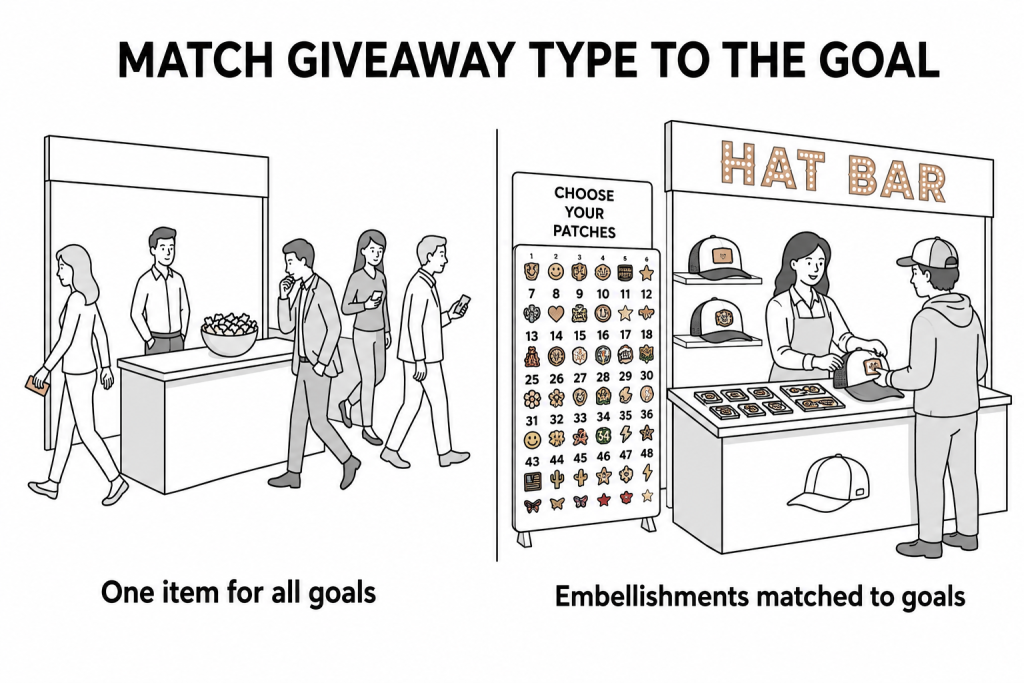
Different goals need different giveaways. A lead-scan campaign, a product demo booth, and a VIP meeting program should not all use the same item.
If your main goal is traffic, choose something easy to understand from a distance. Wearables, tote bags, and visible desk-tech items do that well because attendees recognize the value instantly. If your main goal is qualified pipeline, add a conversation step before the better item is earned.
If your goal is account engagement, use fewer but better pieces. A premium wearable or personalized item can support longer conversations with named accounts better than bulk candy and keychains. If your goal is social visibility, favor items that appear in photos or move around the venue.
One misconception is that every booth needs a giveaway for everyone. In reality, many high-performing booths use a layered approach: open-access swag for reach, then better items for demos, meetings, or decision-makers.
“Raising the Hat Bar says a live custom hat experience supports traffic pull, longer engagement, brand visibility, conversation flow, and post-show value.”
How do tech giveaways compare with wearables and desk items?
Tech wins on utility, wearables win on visibility, and desk items win on staying power. The right category depends on whether you want instant gratitude, public exposure, or steady long-term use.
Side-by-side comparison of tech giveaways, wearable giveaways, and desk items with their main strengths and best-fit booth goals.
Tech products remain popular with attendees, and 4imprint survey reporting cited by PPAI Media found tech products were the most popular promotional products for trade-show attendees. That makes sense. Dead batteries, tangled cords, and missing adapters are real problems on show days. Prispresseren’s guide to the best power banks for travel and commuting notes that capacity, fast-charge standards, and airline-ready sizes are the specs attendees notice first, which reinforces why tech that solves real travel friction gets kept.
The trade-off is cost, compatibility, and in some cases shipping complexity.
Wearables work differently. A good hat or cap may not solve an urgent battery problem, but it can create repeat impressions in airports, offices, and weekends out. That makes wearables especially strong for brand visibility, provided the design feels stylish enough to wear voluntarily.
Desk items are quieter performers. A charging pad, notebook, or tumbler may not draw a crowd, but they can sit in plain sight for months or years. PPAI research from 2021 found 48.7% of respondents kept promotional products for longer than five years, which is a strong argument for durable everyday items.
How can you pick the right giveaway in three steps?
Use a three-step filter. Define the audience, set the use case, and test the experience before you place a large order.
Step 1 is audience definition. Write down who you want to attract most: current customers, named prospects, channel partners, job candidates, or general traffic. If the booth serves multiple groups, decide which group gets the premium item and which gets the mass item.
Step 2 is use-case selection. Ask where the giveaway will actually live. On a desk? In a backpack? At a weekend event? If you cannot picture the item in a real setting, the attendee probably cannot either. That is usually a warning sign.
Step 3 is experience testing. Mock up the handoff, the talking points, and the packaging. If staff need too much explanation, simplify. If attendees have to wait too long, change the flow. A giveaway that works in sourcing samples can still fail on a crowded show floor.
How should you gate premium trade show giveaways without killing traffic?
Gate premium items lightly. The best systems reward engagement without making attendees feel screened out at the entrance.
Step 1 is to create an easy first yes. That can be a low-cost item, a quick game, or a visible sample that invites people closer. Step 2 is to tie the better giveaway to a meaningful action like a demo, a scheduled meeting, or a qualified badge scan. This works because the exchange feels fair, not arbitrary.
Step 3 is script the handoff. Staff should explain the value clearly and consistently: “We’re reserving these for people who stay for the product walkthrough,” or “Design your hat after your demo.” That keeps the booth friendly while protecting budget.
Research reported by PPAI Media found that the most common sales strategy for using promotional products at trade shows was offering them in return for a one-on-one conversation. That is a useful benchmark. If the item is premium, the conversation should be part of the design, not an afterthought.
How can a custom hat bar work as a trade show booth giveaway?
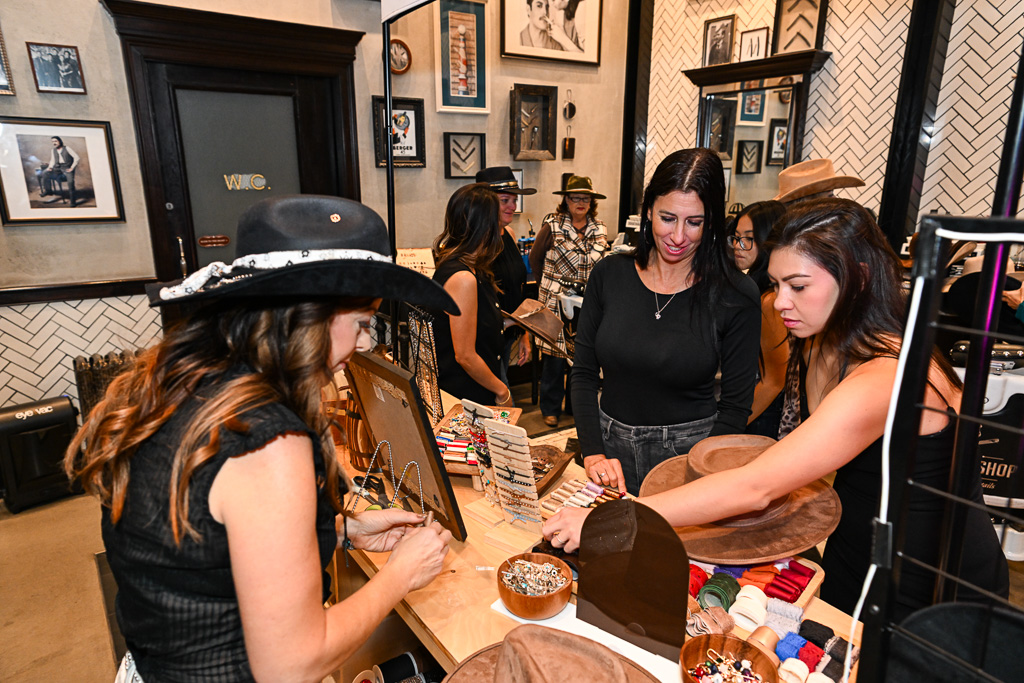
A custom hat bar works as both giveaway and activation. Raising the Hat Bar and similar operators use a staffed station where guests choose a hat, personalize it, and leave with something wearable.
The process is straightforward. First, the attendee chooses a base style, which could include trucker, rancher, or cowboy hats depending on the event. Next, they add materials, accessories, or finishing details. Last, the item is completed on-site with design guidance, so the guest leaves with a finished piece instead of a promise to redeem something later.
This format is strongest when the booth needs dwell time, visible energy, and post-show brand carryover. It also fits Las Vegas especially well because events there often reward experiential formats that can hold attention amid heavy competition. The trade-off is footprint, staffing, and throughput, so it is usually better for targeted engagement than for unlimited volume.
A common misconception is that a hat bar is only right for weddings or social events. In practice, it can also fit corporate exhibits, sponsored lounges, and branded pop-ups when the audience values personalization and the booth has room for a guided station.
“Raising the Hat Bar uses a mobile, staffed setup that lets guests pick a hat and personalize it on-site, creating repeat wear and repeat impressions.”
What budget ranges make sense for trade show giveaway ideas?
Most programs fall into low, mid, and premium tiers. The right budget depends less on price alone and more on quantity, qualification rules, and shipping realities.
A low-cost item can work well for broad traffic if it is genuinely handy. Mid-range pieces often hit the sweet spot for qualified leads. Premium giveaways need stronger gating, but they can carry more weight in account-based marketing or VIP hospitality.
- Low cost: Under about $5 per unit for high-volume reach items like tech cloths, simple totes, or basic desk accessories.
- Mid-range: Roughly $5 to $15 per unit for better bottles, notebooks, phone accessories, and upgraded wearables.
- Premium: About $15 to $40+ per unit for strong hats, power banks, higher-end drinkware, or personalized experiences.
- Activation-based: Higher total spend, but the budget covers staffing, setup, interaction, and the item itself rather than just unit count.
Do not ignore hidden costs. Kitting, rush freight, battery compliance, booth storage, staffing, and post-show leftovers can distort the real economics. A slightly higher unit cost with lower waste can be the better financial choice.
How do you measure whether a trade show giveaway actually worked?
Measure behavior, not just distribution. Leads, dwell time, and follow-up response tell you more than how many pieces left the booth.
Step 1 is to define the primary metric before the show starts. That might be raw scans, qualified meetings, demo completions, social mentions, or target-account engagement. If you skip this step, the giveaway will get judged by volume alone.
Step 2 is to connect the item to a booth action. Track whether attendees who received the premium item stayed longer, booked follow-up calls, or moved faster through the funnel. If there is no link between giveaway and behavior, you are only measuring inventory depletion.
Step 3 is to review post-show signals within 30 to 60 days. Look at reply rates, meeting show-up rates, opportunity creation, and branded-item sightings on social or in later events. That wider view matters because the best giveaways keep working after the booth closes.
“Raising the Hat Bar offers full-service setup, staffing, design guidance, and optional branded elements like logos, pins, and patches, which makes the giveaway easier to tie to a planned event workflow.”