Wearable Event Giveaways: Why Live-Personalized Keepsakes Drive Post-Event Recall
A giveaway can leave the venue with a guest, or it can stay with them long after the lights go down. That difference matters more than many event teams realize.
The strongest post-event recall usually comes from items people actually use, see, and wear again. When that item is personalized live, the effect gets even stronger. It is no longer just swag. It becomes a small act of self-expression tied to a specific moment, place, and feeling.
Why wearable items stay in circulation
Wearables outperform many standard giveaways because they remain visible in everyday life. A tote bag may be useful. A pen may be practical. A hat, jacket, or shirt does something more. It becomes part of a person’s routine and personal style, which gives the event repeated exposure after the event itself is over.
Industry research has shown just how strong that exposure can be. Outerwear and headwear can generate roughly 6,100 impressions per item over time, and promotional product studies regularly show that well over 80% of recipients remember the advertiser tied to the item. That is a very different outcome from giveaways that get used once and tossed in a drawer.
A wristband may help with admission. A custom cap can keep telling the story.
The table below shows why some wearable formats create much stronger recall than others.
| Giveaway type | Typical lifespan | Recall potential | Why it sticks |
|---|---|---|---|
| T-shirts and outerwear | Months to a year or longer | Very high | Large visual area, repeat wear, practical value |
| Hats and caps | Months to years | High | Public visibility, personal style connection, repeat use |
| Lanyards and badges | Usually event-only | Low | Limited use after the event ends |
| Paper or fabric wristbands | Often one day | Low | Short life, low utility afterward |
| Wearable tech | Varies widely | Moderate | Strong novelty, but usefulness depends on fit and quality |
For planners, this shifts the conversation from “What can we hand out?” to “What will people still want next month?”
What live personalization changes
A personalized wearable has an edge before the guest even puts it on. It asks for participation. That moment of choice, selecting a color, picking a patch, adding initials, choosing a trim, pulls the attendee into the experience. The memory begins forming during the making process, not after the item is received.
Research on personalized gifting points in the same direction. Recipients tend to rate personalized items as more emotionally meaningful than identical non-custom items. That makes sense at events too. A mass-produced hat says, “Here is your giveaway.” A live-customized hat says, “This was made with your choices.”
That feeling of ownership changes behavior.
People keep personalized pieces longer, value them more, and are more likely to post them, wear them, and talk about them. At a live station, the keepsake also becomes entertainment. Guests watch others create their items, compare details, snap photos, and share the process.
This is one reason mobile customization activations continue to gain momentum at corporate events, weddings, trade shows, private parties, and festivals. They combine gifting, interaction, and visual content in one footprint.
The psychology behind stronger recall
Memory is rarely built from information alone. It is built from cues, emotion, and repetition.
Wearables work well because they become retrieval cues. Seeing the hat by the door, grabbing it before leaving the house, or getting complimented on it later can bring the event back into focus. Psychologists have long noted that physical objects often serve as anchors for memory. A good wearable item does exactly that.
Personalization deepens this effect because it adds the “generation effect,” a well-known finding in memory research that shows people remember what they help create better than what they passively receive. When guests choose the band, pin, patch, embroidery, or style, they rehearse the experience as they build it. Their attention is active, not passive.
There is also a sensory layer. Touch, texture, color, and movement all support stronger encoding. A custom hat bar is not just visual. Guests handle materials, compare finishes, try on shapes, and respond emotionally to how the final piece feels on them. A purely digital ad cannot replicate that.
Emotion matters too. Events are often built around peaks: a welcome moment, a product reveal, a recognition ceremony, a dance floor, a closing toast. A keepsake connected to one of those moments has a better chance of staying vivid in memory. That is why timing is not a small detail. It is part of the recall strategy.
Relevance beats volume
Many event teams still think about giveaways as a numbers game. More units, more reach. In practice, relevance usually wins.
Recent industry reporting suggests that a large share of consumers are more likely to keep an item when it is handed out at a contextually meaningful moment. A wellness summit, for example, benefits from a wearable item tied to comfort, movement, or outdoor use. A Western-themed fundraiser lands naturally with a custom hat station. A product launch can use colorways, symbols, or patches that connect directly to the campaign theme.
Audience fit matters just as much. Preferences change by age, setting, and identity. A crowd of young creators may respond to bold shapes, trend-led trims, and expressive customization. A corporate audience may lean toward premium materials and understated branding. People also keep items that reflect their culture or personal identity at far higher rates than generic pieces.
After a paragraph of planning, this is where many teams benefit from asking a few sharper questions:
- Audience match: Is this item something attendees would wear outside the event?
- Brand fit: Does the branding feel stylish enough to keep?
- Event timing: Are you giving it at a moment people will remember?
- Personal choice: Can guests make it feel like their own?
- Longevity: Will it still be useful in 30, 90, or 180 days?
A relevant wearable does not feel promotional in the usual sense. It feels chosen.
Why hats are especially effective
Headwear sits in a sweet spot between utility and personality. It is visible, wearable across seasons, easier to size than apparel, and flexible enough to suit many event styles. Trucker hats, rancher hats, cowboy hats, and fashion-forward felt styles all offer different visual languages while serving the same purpose: repeat wear and repeated brand exposure.
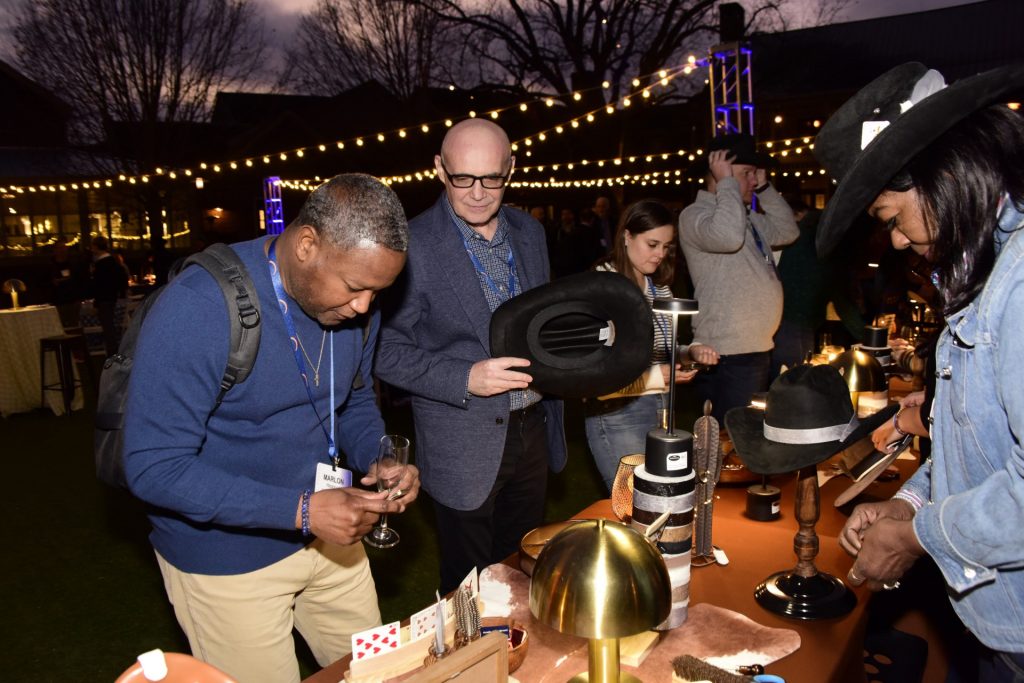
That is one reason custom hat bars have become a strong option for experiential events. At Raising the Hat Bar, the model is straightforward: guests choose a hat base, work with guided styling support, add trims and embellishments, and leave with a finished piece they can wear right away. For corporate events, branded patches, pins, or subtle logo details can be integrated without turning the item into a walking billboard.
That balance is important.
If the branding overwhelms the design, the item stops feeling personal. If the design feels elevated and the branding is integrated with restraint, the hat has a much better chance of entering real wardrobe rotation. That is where recall compounds over time.
There is also an operational upside. Hats are highly photogenic, instantly wearable, and easy to feature in social content. A guest does not need to go home and style the item later. The transformation happens on site.
Measuring whether it worked
Post-event recall should be treated as something measurable, not just intuitive. The strongest activations tend to perform well across both emotional response and visible metrics.
A live-personalized wearable usually increases dwell time at the activation because guests spend time choosing and creating. It also increases the odds of user-generated content because the making process itself is worth filming. Then the item continues working after the event through repeat wear, brand impressions, and conversation.
That gives planners a cleaner set of signals to watch:
- Dwell time
- Social posts and tagged photos
- Unprompted brand recall in post-event surveys
- Return attendance or follow-up interest
- Referral traffic or QR visits tied to the activation
Those signals matter more than raw unit count. A thousand basic giveaways can disappear quietly. A few hundred custom wearables can create longer lines, stronger social sharing, better sentiment, and a much longer memory tail.
For trade shows and branded environments, the business value can be even clearer. Promotional product studies often show strong lift in favorable brand opinion and purchase intent after recipients receive useful branded merchandise. When the item is made live and personalized, it gains another layer of meaning that standard swag rarely reaches.
A smarter approach to giveaway strategy
The best event giveaways do not behave like giveaways. They behave like experiences with a wearable result.
That is why live-personalized keepsakes are gaining ground across industries. Corporate teams want activations that feel premium and interactive. Wedding hosts want something guests will keep. Festival organizers want visual energy and social sharing. Brand marketers want recall that lasts beyond the event floor. A personalized wearable can answer all four goals at once.
There is also a quiet shift happening in event design. People are less impressed by quantity and more responsive to care, relevance, and participation. A guest who walks away with a custom piece they helped shape is carrying more than a product. They are carrying proof that the event had texture, intention, and style.
For planners in Las Vegas and beyond, that opens up a more ambitious standard for swag. Instead of asking what is cheapest to distribute, it may be better to ask what guests will be proud to wear again. That is where memory lives, and where the right keepsake keeps working long after the room is cleared.