Capacity Planning: How Many Guests Can a Hat Bar Serve Per Hour?
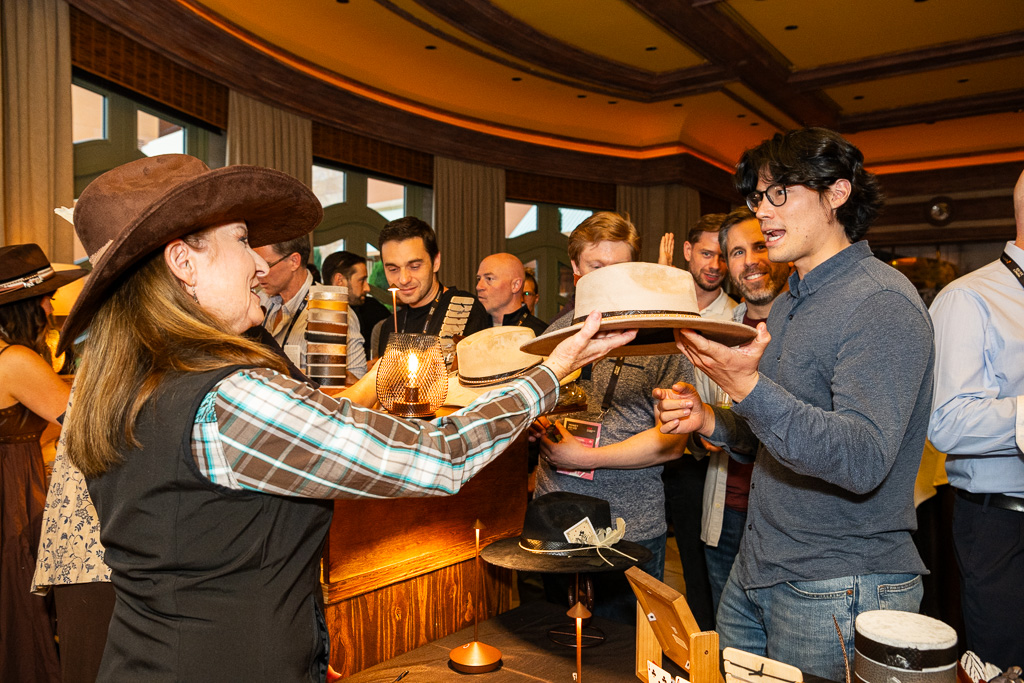
Capacity is the quiet engine behind every great activation. When guests can step up, design something personal, and walk away wearing it, the experience feels effortless. When the line creeps and decisions stall, even the best-looking setup starts to feel cramped.
A hat bar is both retail and performance: it’s creative, guided, and tactile. That combination is why it’s memorable, and also why capacity planning deserves real math instead of guesses.
Throughput starts with a simple question
“How many guests can we serve per hour?” sounds straightforward until you define what “serve” means.
At a custom hat bar, “served” usually means a guest completes the full arc: chooses a base hat, selects embellishments, gets fit guidance, and leaves with a finished piece. If your event goal is “everyone gets a hat,” you’re planning for a very different workload than “a highlight activation where a portion of guests participates.”
One useful mindset is to plan around the busiest hour, not the average hour. Peak demand tends to cluster right after doors open, during cocktail hour, between sessions at a conference, or when dinner transitions into dancing.
What actually sets the capacity per hour
At Raising the Hat Bar, reported build times often fall into two common lanes: a straightforward trucker hat with a patch can take about 4 to 6 minutes, while a more involved felt rancher can take about 8 to 12 minutes. That spread is the heart of throughput planning.
Speed depends on more than the clock, though. The system matters: staffing, role clarity, layout, and how curated the menu of options is. With multiple stylists operating in parallel, it can be realistic for a hat bar to handle roughly 60 to 120 guests per hour, especially when choices are tuned for volume.
A fast way to estimate guests served per hour
Capacity planning gets easier when you treat each hat as a repeatable service cycle.
A practical back-of-napkin model looks like this:
Guests per hour ≈ (Number of active build positions) × (60 ÷ average minutes per hat)
“Build positions” may be individual stations, or distinct seats on a long counter where a stylist can truly work in parallel. If one stylist is doing everything alone, you effectively have one build position. If an assistant preps patches, stages bands, handles sizing inserts, and bags the finished hat, that stylist’s build position becomes faster and more consistent.
After you calculate the number, apply a realism factor. Interruptions happen. Guests change their mind. A patch runs low and needs a swap. People stop to take photos.
Many teams plan on a buffer that reduces the theoretical maximum, aiming for a pace they can hold without rushing the guest experience.
The biggest throughput variables, ranked by impact
The same hat bar can feel “instant” at one event and “worth the wait” at another. The difference usually comes down to a handful of controllable levers.
After you’ve decided your participation goal, focus on the variables that move capacity the most:
- Staffing density: More stylists means true parallel work, not just faster work.
- Role separation: A lead stylist designing while an assistant preps and finishes cuts idle time.
- Complexity mix: Trucker hats with a patch move faster than felt hats with layered trims.
- Decision time: Guests who arrive knowing what they want reduce cycle time dramatically.
- Restocking rhythm: If supplies live “behind the bar” with no runner, the station pauses.
Industry staffing guides for beverage service often cite ratios around one bartender per 35 to 50 guests, with tighter ratios for complex cocktails. A hat bar is not a bar, yet the operational lesson carries over: one missing team member can turn a line into the main event.
The layout factor: capacity is partly architecture
A hat bar can have excellent staff and still feel slow if the physical flow forces bottlenecks. The ideal layout makes the next step obvious without needing verbal instructions.
Think in zones:
- Welcome and base-hat selection
- Design choices and styling guidance
- Build and finishing tools (heat tools, adhesives, presses as needed)
- Mirror and photo moment
- Bag-and-go pickup
That last zone matters more than it gets credit for. If finished hats stack up at the build counter because there’s no clear handoff point, you lose minutes on every cycle. Small frictions compound quickly at peak hour.
Many mobile bar setup guidelines recommend enough counter frontage per server to avoid collisions and slow handoffs. The same principle applies here: give each stylist real working space, and keep the guest-facing displays reachable without crossing the “tool line.”
Speed without sacrificing the creative feel
Guests want freedom, yet too many options can quietly reduce capacity. Decision-making time is part of the service cycle.
A strong approach is to keep the experience open-ended while still guiding it. Sample hats do a lot of work here. When guests can point to a finished look and say “that, but in black,” the design portion becomes faster and more confident.
After you’ve framed the aesthetic, then you can tune for volume with curated choices:
- Shortlists of the most-loved patches and pins
- Pre-paired band-and-trim combinations
- A “fast track” lane for simpler builds
- A premium lane for complex felt designs
Guests still get self-expression, and the line stays steady.
Capacity ranges you can plan around
The numbers below are planning ranges for peak hour, assuming a guided, full-service experience. They reflect common build-time patterns (roughly 4 to 12 minutes depending on hat type), plus the reality that parallel stations are how activations scale.
| Event context | Typical setup approach | Peak capacity planning range (guests served/hour) | What usually drives the number |
|---|---|---|---|
| Private party (up to ~50 guests) | 1 station with clear roles | 15 to 30 | Design complexity and how quickly guests decide |
| Wedding events (~75 to 150 guests) | 1 to 2 stations, photo-friendly flow | 35 to 70 | Cocktail-hour surge and mix of hat styles |
| Corporate reception (~200 to 500 guests) | Multiple stations with branded elements | 60 to 120 | Parallel workstations and curated option sets |
| Festival or large community event (500+ attendees) | Several stations, simplified menu | 100+ | Throughput-focused choices and line management |
These ranges assume you are measuring the busiest hour. Off-peak hours can be meaningfully slower, not because the team is slower, but because demand thins.
A planner’s way to translate capacity into a confident quote
Event owners rarely ask for “guests per hour” just for fun. They’re trying to answer questions like:
- How long will the line be?
- How many hats should we budget?
- Do we need one station or four?
- Can we promise VIPs a quick experience?
A clean way to translate throughput into a participation plan is:
- Estimate how many guests will truly participate (often not 100%).
- Identify the time windows when they will show up.
- Staff for those windows, not for the quiet parts.
If you expect 250 guests and assume 40% participation, that’s 100 hats. If 70% of that participation hits in the first 90 minutes, you are effectively planning for about 70 hats in 1.5 hours, or about 47 hats per hour. That is the number you staff for.
Operational tactics that reliably raise throughput
Small improvements compound when a line forms. After you map your flow, pick a few high-impact tactics and commit to them.
Here are levers that tend to move the needle without turning the activation into a factory:
- Visual menu: Sample hats that show “finished outcomes,” not just ingredients.
- Two-lane service: A fast lane for simple builds and a custom lane for complex builds.
- Pre-staged kits: Bundles of popular patches, pins, and bands ready to grab.
- Dedicated finishing: One person focused on heat tools, adhesives, and final checks.
And if you want a quick “roles” template that works across many event sizes, keep it simple:
- Lead stylist: Guides the look, confirms placement, keeps the guest moving forward.
- Assistant: Preps materials, manages sizing inserts, handles bagging and handoff.
- Runner (optional at scale): Restocks blanks and top-selling embellishments before they run out.
That separation is often the difference between a line that moves and a line that stalls.
Planning for spikes without overstaffing the whole event
A smart plan anticipates the surge, then relaxes.
If your schedule allows it, a VIP preview window can remove pressure from the peak. Weddings might do this with the couple and bridal party before general flow. Corporate teams might reserve the first few minutes for executives or speakers.
When spikes do hit, the fastest pressure-release valve is choice curation. Fewer decisions means fewer minutes per hat, which is the only way to increase capacity without adding stations.
Brand activations: capacity is part of the message
Corporate events often care about brand integration, not only volume. Branded patches, pins, or logo details can be built into a high-throughput workflow, but they should be designed for speed from the start.
A few practical guidelines help keep branded moments polished at scale:
- Avoid brand marks that require fussy alignment or tiny placements.
- Choose decoration formats that apply quickly and consistently.
- Make the branded element the anchor, then give guests controlled freedom around it.
When the brand moment is clean and the line is moving, the activation feels premium, not crowded.
The question to ask before you finalize the station count
Before you lock in how many stations you need, ask one clarifying question:
What experience do you want your guests to remember, the hat itself or the wait to get it?
If the goal is a high-touch design moment, plan slightly below theoretical max capacity and keep the pacing calm. If the goal is broad distribution at a conference or festival, tune the menu, add parallel stations, and treat the first hour like showtime.
Either way, capacity planning is what lets a hat bar feel generous: plenty of time for style, zero drama in the line, and a souvenir guests keep wearing long after the event is over.